
Published November 23, 2026 | RichInWriters Science, Technology and Discovery
Bismuth Ferrite, UFO Technology and Bob Lazar: Could Multiferroic Materials Unlock New Physics?
What if some of the most interesting technological discoveries of the future are hidden in materials composed of elements that humanity has known about for centuries?
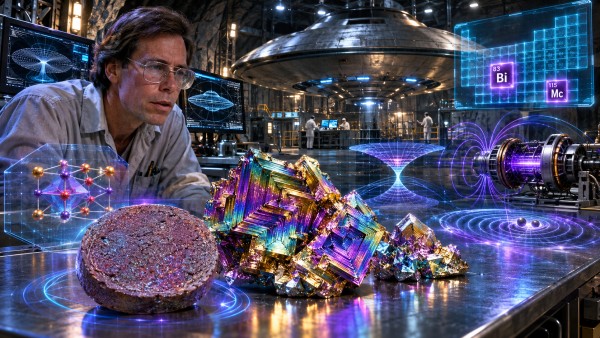
Consider bismuth ferrite (BiFeO3), an unusual crystalline material composed of bismuth, iron and oxygen.
Under the right conditions, scientists can use electricity to change aspects of its magnetic structure, manipulate microscopic conducting pathways and produce mechanical responses within the material itself.
These are not claims originating from UFO documentaries or speculative internet discussions. They are properties that scientists have investigated and demonstrated in laboratories.
However, these discoveries also raise interesting questions for people who follow Bob Lazar, UFO technology, unidentified anomalous phenomena (UAP), electromagnetic propulsion and alternative theories of gravity.
Could advanced materials eventually allow humanity to develop technologies that appear to defy our conventional understanding of engineering?
Could future discoveries involving electricity, magnetism and crystalline structures change how we approach spacecraft design?
And could some of the unusual materials discussed by UFO researchers have properties that deserve further scientific investigation?
We're not suggesting that bismuth ferrite is extraterrestrial technology or that scientists have discovered how to cancel gravity. Instead, we're exploring where established materials science ends and the fascinating world of technological speculation begins.
What Is Bismuth Ferrite?
Bismuth ferrite is an inorganic compound with the chemical formula BiFeO3, sometimes abbreviated as BFO.
It consists of three elements:
- Bismuth (Bi): Atomic number 83
- Iron (Fe): Atomic number 26
- Oxygen (O): Atomic number 8
Individually, these elements are relatively familiar.
Iron has been used in tools, machinery and construction for thousands of years. Oxygen is essential to much of life on Earth. Bismuth is a heavy metal used in pharmaceuticals, specialized alloys and various industrial applications.
But when these elements combine within a particular crystalline structure, they produce a material with properties that are very different from those of its individual ingredients.
Bismuth ferrite belongs to a category of materials known as multiferroics.
What Are Multiferroic Materials?
Multiferroic materials exhibit more than one type of ferroic order within the same material.
In the case of bismuth ferrite, the two properties attracting particular scientific attention are:
- Ferroelectricity: The material possesses an internal electric polarization that can be changed by applying an electric field.
- Antiferromagnetism: The magnetic moments within the material develop an ordered arrangement, with neighbouring moments pointing in approximately opposite directions.
What makes bismuth ferrite particularly interesting is that both forms of order exist at ordinary room temperatures.
Many other materials exhibiting comparable combinations of properties require specialized temperature conditions.
More importantly, the electrical and magnetic properties of bismuth ferrite are connected.
This phenomenon is known as magnetoelectric coupling.
Bismuth Ferrite Properties at a Glance
| Property | Description |
|---|---|
| Chemical formula | BiFeO3 |
| Molar mass | 312.82 g/mol |
| Material category | Multiferroic ceramic |
| Crystal structure | Distorted perovskite |
| Electric properties | Ferroelectric |
| Magnetic properties | Primarily antiferromagnetic |
| Magnetic ordering temperature | Approximately 370 degrees Celsius |
| Ferroelectric Curie temperature | Approximately 830 degrees Celsius |
| Bulk magnetic spin cycloid period | Approximately 62 nanometres |
| Optical band gap | Approximately 2.7 electron volts in well-characterized samples |
These are approximate scientific reference values. Actual measurements can vary depending on the material's composition, crystal quality, manufacturing process and physical structure.
Electricity and Magnetism: Why This Material Is So Interesting
Most people are familiar with an electromagnet.
When electricity flows through a coil of wire, it creates a magnetic field. This principle is used in electric motors, speakers, generators and numerous other technologies.
But bismuth ferrite offers a different possibility.
Rather than relying exclusively on an electric current flowing through a coil, engineers can investigate how an applied electric field changes the internal magnetic arrangement of a material.
Imagine being able to rearrange the magnetic properties of a microscopic component simply by applying a voltage.
That could have significant implications for energy-efficient computing, sensors and advanced electronic systems.
However, changing the magnetic orientation of a material is not the same as creating energy from nothing or generating an unlimited magnetic field.
The material still operates within physical and energetic constraints.
Scientists Demonstrated Electrical Control of Magnetism in 2014
In December 2014, researchers published a particularly important study in the scientific journal Nature entitled Deterministic switching of ferromagnetism at room temperature using an electric field.
Researchers associated with Cornell University, Lawrence Berkeley National Laboratory and other institutions investigated how an electric field could control magnetism in a device incorporating bismuth ferrite.
The researchers demonstrated that an electrical signal could reverse magnetic orientation through a sequence of internal switching events.
By coupling the bismuth ferrite to a neighbouring magnetic layer, the researchers demonstrated an approach to electrically controlled magnetic devices.
This was especially interesting because previous theoretical considerations had suggested that the desired direct switching process faced fundamental obstacles.
The researchers found a different route through the material's switching behaviour.
The significance of this discovery extends beyond bismuth ferrite itself. It demonstrates how investigating the internal behaviour of materials can reveal engineering possibilities that were previously considered difficult or inaccessible.
Could the Internal Structure of a Material Be More Important Than Its Ingredients?
This question should be particularly interesting to researchers investigating unconventional aerospace materials.
A material's chemical composition tells us which elements are present.
But it does not necessarily tell us how those elements are arranged or how the resulting material will behave.
Consider carbon.
Graphite, diamond and graphene all consist of carbon atoms, yet their physical properties are dramatically different.
Diamond is extremely hard. Graphite is comparatively soft. Graphene has remarkable electrical and mechanical properties.
The difference is largely how the carbon atoms are organized.
Bismuth ferrite provides another example of why atomic arrangement matters.
Scientists can modify its behaviour by changing its crystal structure, applying mechanical strain, altering its composition or manufacturing it in extremely thin layers.
Two samples with the same nominal chemical formula may exhibit substantially different electrical and magnetic characteristics.
That principle is important when evaluating claims about unusual metallic fragments allegedly recovered from UFOs.
Identifying familiar elements does not necessarily reveal every possible technological function of a material. However, unusual behaviour must still be demonstrated through actual experiments.
Scientists Discovered Conducting Pathways Inside Bismuth Ferrite
In 2009, researchers at Lawrence Berkeley National Laboratory and the University of California, Berkeley reported another remarkable property of bismuth ferrite.
Although the surrounding material was electrically insulating, certain microscopic boundaries within it could conduct electricity.
These boundaries are called ferroelectric domain walls.
To understand the discovery, imagine a crystal containing different regions where electrical polarization points in different directions.
The boundary separating two such regions may have electrical properties different from those of the surrounding material.
Researchers observed conducting boundaries approximately two nanometres wide.
Furthermore, scientists are interested in whether electric fields can reposition or modify such boundaries.
That creates an intriguing possibility: microscopic electrical pathways that can potentially be reconfigured rather than permanently manufactured into a component.
Future applications could include extremely compact electronics, adaptable circuits and new forms of information storage.
What Does This Have to Do With Bob Lazar?
Anyone who has followed the UFO phenomenon for an extended period has probably encountered the name Bob Lazar.
Lazar became widely known in 1989 after claiming that he had worked on a secret program involving extraterrestrial spacecraft near Nevada's Area 51.
He described an alleged facility called S-4, where he claimed scientists were attempting to understand and reverse-engineer advanced propulsion technology.
According to Lazar's account, the spacecraft operated using technology that manipulated gravity rather than relying on conventional rocket propulsion.
His claims included references to:
- Gravity amplifiers
- An unusual propulsion reactor
- Distortions of spacetime
- A stable form of element 115
- Technology allegedly capable of producing extraordinary spacecraft manoeuvres
These claims remain unverified.
Lazar has not publicly produced a functioning gravity-manipulation device or an independently authenticated sample of the stable element he described.
No independently established connection between Bob Lazar and bismuth ferrite has been demonstrated.
Nevertheless, the conceptual connection is interesting.
Lazar's story revolves around the possibility that unusual materials and advanced physical interactions could produce technological effects beyond conventional aerospace engineering.
Modern multiferroic research demonstrates that ordinary terrestrial elements, arranged in particular ways, can exhibit unexpected and potentially useful interactions between electricity and magnetism.
That does not validate Lazar's account. But it provides scientifically credible subject matter for people interested in how unconventional technologies might eventually develop.
Element 115: Was Bob Lazar Proven Right?
One of the most commonly discussed aspects of Lazar's account involves element 115.
Scientists eventually synthesized element 115 in laboratory experiments reported in 2004, and it received the official name moscovium (Mc) in 2016.
Some UFO enthusiasts have interpreted this development as confirmation of Lazar's claims.
However, the existence of an element with atomic number 115 was scientifically anticipated long before its successful synthesis.
The periodic table organizes elements according to their number of protons. Scientists already understood that an element containing 115 protons would occupy a corresponding position if it could be produced.
The difficult question was whether particular isotopes could be created and how long they would survive.
Known isotopes of moscovium are highly radioactive and short-lived.
No stable isotope with the extraordinary propulsion properties described by Lazar has been independently demonstrated.
The creation of moscovium confirmed the existence of element 115, not the existence of Lazar's alleged spacecraft propulsion system.
Bismuth and Moscovium Are Not the Same Material
Interestingly, bismuth and moscovium occupy the same broad chemical family in the periodic table.
Both belong to Group 15, a family that also includes nitrogen, phosphorus, arsenic and antimony.
Bismuth has 83 protons, whereas moscovium has 115.
However, membership in the same periodic-table group does not mean these elements possess identical properties.
Superheavy elements can behave differently from lighter elements because of their nuclear instability and relativistic effects involving their electrons.
There is currently no established evidence that bismuth ferrite possesses the gravitational properties attributed to element 115 in Lazar's account.
The relationship is an interesting scientific comparison rather than proof of a technological connection.
Why Bismuth Is Already Part of UFO Materials Research
Perhaps the most fascinating connection between bismuth and UFO research involves a disputed metallic specimen that has received considerable attention within the UAP community.
For years, researchers and commentators have discussed unusual layered materials allegedly recovered from unidentified spacecraft.
One particularly well-known specimen contained magnesium, zinc, bismuth and other elements, including lead.
The specimen has sometimes been discussed in connection with material allegedly recovered from a crashed spacecraft in or around 1947.
Claims surrounding it included the possibility that its layered structure could interact with terahertz electromagnetic radiation and produce unusual effects involving inertia or gravity.
Unlike many UFO stories, this particular specimen eventually became the subject of an official laboratory investigation.
To The Stars Academy and the U.S. Army Investigated Unusual Materials
To The Stars Academy, associated with musician and UFO researcher Tom DeLonge, has been involved in efforts to investigate unusual materials and reported aerospace technologies.
The organization entered into a research arrangement with the U.S. Army's Combat Capabilities Development Command to evaluate potential technological applications of a disputed metallic specimen.
The specimen was subsequently studied through an arrangement involving the Pentagon's All-domain Anomaly Resolution Office (AARO) and Oak Ridge National Laboratory.
This is significant because the investigation moved beyond eyewitness testimony and into laboratory analysis.
Scientists had a physical object whose properties could be examined.
What Did Oak Ridge National Laboratory Discover in 2024?
Oak Ridge National Laboratory examined the specimen's chemical composition, microscopic structure and isotopic characteristics.
Researchers investigated whether the object appeared terrestrial in origin and whether its bismuth-containing layers met the requirements necessary to function as a terahertz waveguide.
The laboratory concluded that the available evidence strongly supported a terrestrial manufactured origin.
It also found that the specimen did not possess the structure required for the proposed waveguide function.
Although its original purpose and complete history remain uncertain, the physical evidence was consistent with experimental human manufacturing rather than extraterrestrial engineering.
AARO's supplementary report, published in July 2024, suggested that the material was compatible with historical magnesium-alloy research and manufacturing experiments.
The investigation did not establish antigravity, inertial mass reduction or extraterrestrial technology.
Importantly, the specimen examined was not bismuth ferrite. It was a different material containing bismuth within a layered metallic structure.
The presence of the same element in both materials should not be confused with evidence that they perform the same function.
What Is a Terahertz Waveguide?
Terahertz radiation is a form of electromagnetic radiation occupying a frequency range between conventional microwaves and infrared radiation.
One terahertz represents one trillion oscillations per second.
A waveguide is a structure designed to direct electromagnetic waves along a particular path.
Waveguides are legitimate engineering technologies used in communications, radar, microwave systems and scientific equipment.
Materials engineered at extremely small scales can interact with electromagnetic radiation in ways that depend on their internal structure.
Researchers continue investigating terahertz technologies for imaging, communications, sensing and spectroscopy.
However, terahertz electromagnetic waves are not gravitational waves.
Guiding electromagnetic radiation through a material does not establish an ability to manipulate gravity or remove the inertia of a spacecraft.
Could Bismuth Ferrite Be Used as a Metamaterial?
The term metamaterial frequently appears in discussions about unconventional aerospace technology.
In legitimate scientific research, metamaterials are engineered structures that obtain distinctive physical properties partly through their internal arrangement.
For example, scientists can design structures that influence:
- Electromagnetic waves
- Light
- Sound
- Mechanical vibrations
- Heat transfer
- Radio-frequency signals
A metamaterial does not need to contain unfamiliar elements.
Its unusual behaviour may come from arranging familiar materials in carefully designed patterns.
Bismuth ferrite is not automatically a metamaterial merely because it is multiferroic.
However, its properties could potentially make it useful as a component in engineered thin-film structures, composites and electrically controlled devices.
Whether a particular structure provides useful electromagnetic behaviour would depend on its design and experimental performance.
Can Bismuth Ferrite Defy Gravity?
There is currently no established experimental evidence that bismuth ferrite cancels gravity, produces gravitational shielding or reduces inertial mass.
But understanding why requires distinguishing magnetism from gravity.
A magnet can attract certain objects. Under suitable circumstances, magnetic forces can also cause an object to levitate.
People have demonstrated magnetic levitation using superconductors, powerful electromagnets and diamagnetic materials.
Elemental bismuth is itself diamagnetic, meaning it develops a magnetic response that opposes an applied magnetic field.
That property makes bismuth interesting in certain magnetic levitation experiments.
However, magnetic levitation does not eliminate gravity.
Instead, another force acts against the object's weight.
An aircraft also remains above the ground without eliminating gravity. Its wings generate aerodynamic lift.
Similarly, magnetic levitation demonstrates the ability to counteract gravitational attraction with another force, not necessarily to modify gravity itself.
Gravitational Waves and Our Evolving Understanding of Gravity
In a previous RichInWriters article, we examined how humanity's understanding of gravity has evolved since Sir Isaac Newton published his mathematical theory of universal gravitation in 1687.
Newton described gravitational attraction through mathematical laws.
Albert Einstein subsequently developed general relativity, describing gravity through the geometry of spacetime.
In 2015, scientists directly detected gravitational waves, confirming a major prediction of Einstein's theory.
These discoveries demonstrate that gravity is not merely an isolated subject involving falling objects.
It is connected to the structure and behaviour of spacetime itself.
Because mass and energy influence spacetime according to general relativity, electromagnetic fields also contribute to gravitation through their energy.
However, the gravitational effects of ordinary laboratory electromagnetic fields are extraordinarily small.
There is no established method for using bismuth ferrite or comparable materials to amplify those effects into practical gravity-based spacecraft propulsion.
Nevertheless, the relationship between quantum physics, energy and gravity remains an active area of scientific investigation.
Why Electricity, Magnetism and Gravity Should Not Be Confused
Electricity and magnetism were once studied as seemingly separate phenomena.
During the nineteenth century, discoveries by researchers including Michael Faraday and James Clerk Maxwell helped establish that they were interconnected aspects of electromagnetism.
Today, our understanding of this relationship supports enormous portions of modern civilization.
Electric motors, generators, telecommunications, computers and wireless technologies all rely on electromagnetic principles.
Some theoretical physicists have investigated whether gravity and the other fundamental interactions can be understood within a deeper unified framework.
However, no experimentally established theory currently provides an engineering method for converting conventional electromagnetic fields into controllable antigravity.
Magnetoelectric materials demonstrate connections between electrical and magnetic behaviour within matter.
They do not, by that fact alone, establish a new connection between those properties and gravitational propulsion.
What Are the Real Commercial Applications of Bismuth Ferrite?
Even without speculative spacecraft technology, bismuth ferrite has an impressive range of potential applications.
1. Energy-Efficient Computers and Spintronics
Traditional electronic devices primarily use electrical charge to store and process information.
Spintronics investigates how the magnetic properties of electrons can also be used in information technology.
Electrically controlling magnetic orientation could contribute to memory and logic devices that require less energy for certain operations.
For future data centres, artificial intelligence systems and portable electronics, reduced energy consumption could have substantial economic value.
2. Advanced Computer Memory
Multiferroic materials are being investigated for memory devices capable of retaining information when external power is removed.
Researchers hope to combine electrical writing with magnetic or electrical reading in new device architectures.
The challenge is converting laboratory demonstrations into reliable components that can be manufactured economically at enormous scale.
Switching speed, durability, data retention and manufacturing consistency remain important considerations.
3. Sensors and Miniature Actuators
Bismuth ferrite can respond electrically to mechanical strain and can undergo small physical changes when subjected to an electric field.
These properties are useful in the study of piezoelectric materials.
Potential applications include precision sensors, miniature positioning systems, vibration measurements and electrically controlled mechanical components.
Such technologies could eventually have applications in robotics, medical instruments and aerospace equipment.
4. Solar Energy and Photovoltaic Research
Researchers have also investigated unusual photovoltaic effects in ferroelectric materials.
Certain bismuth ferrite structures have produced open-circuit voltages exceeding what might ordinarily be expected from their optical band-gap voltage.
However, high voltage does not automatically mean high energy production.
Electrical power depends on both voltage and current.
An impressive voltage measurement may have little commercial value if the material delivers insufficient current under load.
There is currently no basis for describing bismuth ferrite as a commercially proven replacement for conventional solar panels.
5. Environmental Technologies
Bismuth ferrite can absorb portions of visible light, making it interesting to researchers investigating photocatalysis.
Photocatalysis involves using light to help initiate or accelerate chemical reactions.
Researchers have investigated bismuth ferrite-based materials for applications such as breaking down organic pollutants and facilitating photoelectrochemical reactions.
These applications still face challenges involving material efficiency, charge recombination, durability and commercial scalability.
6. Reconfigurable Electronics
The discovery of conducting domain walls could eventually contribute to electronic systems capable of modifying internal current pathways.
Rather than designing every electrical path as a permanently fixed component, engineers may investigate materials in which certain pathways can be changed.
Such capabilities could be valuable in adaptive electronics and specialized computing architectures.
Why Is Bismuth Ferrite Difficult to Manufacture Consistently?
One of the challenges with advanced materials is the difference between successfully producing a small laboratory sample and economically manufacturing millions of reliable components.
Bismuth ferrite is particularly sensitive to manufacturing conditions.
Researchers must consider factors including:
- Processing temperature
- Loss of bismuth during heating
- Oxygen vacancies
- Unwanted secondary chemical compounds
- Crystal orientation
- Mechanical strain
- Electrical leakage
- Impurities and manufacturing defects
Electrical leakage is an especially important challenge because unwanted current can interfere with measurements of the material's true ferroelectric behaviour.
In some circumstances, an apparently extraordinary electrical measurement may partly reflect defects rather than an intrinsic property of the material.
This is why scientists use multiple measurement techniques to confirm their results.
It is also why independent laboratory replication matters so much when evaluating claims about unusual materials.
What Other UFO Researchers Have Discussed Advanced Materials?
Bob Lazar is not the only person associated with theories concerning unusual spacecraft materials.
Several scientists, journalists, former officials and independent researchers have expressed interest in investigating physical evidence associated with unidentified anomalous phenomena.
Jacques Vallée
Jacques Vallée is a computer scientist, author and longtime UFO researcher who has emphasized the importance of investigating unusual phenomena through evidence rather than immediately assuming a particular explanation.
His work has included interest in physical material samples associated with reported UFO incidents.
Garry Nolan
Garry Nolan is a Stanford University professor known primarily for his research in immunology and related scientific fields.
He has also publicly expressed interest in analyzing unusual materials associated with UAP reports.
The use of sophisticated analytical instruments to investigate these materials is scientifically legitimate, regardless of whether the objects ultimately have conventional explanations.
Linda Moulton Howe
Investigative journalist and UFO commentator Linda Moulton Howe has frequently discussed alleged anomalous metallic fragments, including layered bismuth-containing materials.
Some of the extraordinary technological interpretations associated with such fragments remain unsupported by controlled experimental evidence.
Tom DeLonge
Through To The Stars Academy, Tom DeLonge helped bring public attention to claims involving unidentified aerial phenomena, unusual materials and possible advanced aerospace technologies.
The subsequent laboratory investigation of a disputed specimen demonstrates why physical testing can be more informative than speculation alone.
David Grusch
Former U.S. intelligence official David Grusch attracted international attention in 2023 after publicly alleging the existence of concealed UAP retrieval and reverse-engineering programs.
His allegations helped stimulate further public and congressional discussion about government transparency.
However, his public testimony did not independently establish the existence of extraterrestrial spacecraft or operational antigravity technology.
Avi Loeb
Harvard astrophysicist Avi Loeb has advocated investigating whether unusual astronomical objects or phenomena could involve advanced extraterrestrial technology.
His approach has generated both interest and scientific criticism.
The broader question of how humanity would recognize technology originating outside Earth remains an interesting scientific problem.
Why Advanced Materials Could Change the Future of Space Exploration
Spacecraft engineering involves far more than propulsion.
Every kilogram of equipment, every watt of electricity and every component that must survive extreme conditions presents an engineering challenge.
Advanced materials could contribute to spacecraft through:
- More energy-efficient onboard computers
- Smaller and lighter sensors
- Improved electronic memory
- Precision positioning systems
- Electromagnetic sensing
- Adaptive communications equipment
- Vibration monitoring
- Specialized energy conversion devices
These are plausible areas where developments involving complex materials could eventually improve aerospace technology.
That does not mean the next generation of spacecraft will necessarily use bismuth ferrite.
But advanced materials research is one of the areas where seemingly modest laboratory discoveries can eventually produce enormous technological changes.
Could Future Technology Appear Impossible to Us Today?
Imagine someone living in the seventeenth century being shown a modern smartphone.
Without knowledge of semiconductors, wireless communications, satellites and digital computing, the device might appear incomprehensible.
Yet every major function of that device can be investigated and explained using physical principles we understand today.
The same consideration applies to speculation about future aerospace technologies.
Humanity may eventually develop materials and devices that perform functions we currently cannot achieve.
Those discoveries could result from improved engineering rather than the violation of established physical laws.
Alternatively, future experiments could reveal limitations in existing scientific theories and require more comprehensive explanations.
We should remain open to both possibilities without assuming that every extraordinary claim is true.
What Would It Take to Prove a Material Can Manipulate Gravity?
Suppose researchers discovered a material that appeared to produce an unexplained reduction in weight when an electrical or magnetic field was applied.
That would certainly deserve investigation.
However, scientists would first need to determine whether the apparent effect could be explained by conventional processes.
These could include:
- Electromagnetic forces
- Electrostatic attraction or repulsion
- Temperature changes
- Air movement
- Mechanical vibration
- Electromagnetic interference with measuring equipment
- Experimental calibration errors
Only after conventional explanations were adequately excluded could researchers begin making a credible case for previously unknown physics.
Independent laboratories would need to reproduce the effect under controlled conditions.
Researchers would also need to establish whether momentum and energy were being conserved and whether the observations were consistent with genuine gravitational changes.
An unexplained observation is the beginning of a scientific investigation, not automatically its conclusion.
Is Bismuth Ferrite an Investment Opportunity?
From a business perspective, the most credible investment opportunities associated with multiferroic materials may have relatively little to do with UFOs.
Potential commercial sectors include:
- Semiconductor manufacturing
- Advanced computer memory
- Energy-efficient artificial intelligence hardware
- Specialized sensors
- Precision engineering
- Advanced ceramics
- Thin-film manufacturing
- Photonics and electromagnetic technologies
These markets already have identifiable industrial requirements.
A company capable of reliably producing an electrically controlled magnetic component that reduces energy consumption or improves performance could potentially create a commercially valuable product.
However, investors should distinguish laboratory innovation from profitable manufacturing.
Scientific publications do not automatically translate into patent ownership, scalable production, customer demand or profitable businesses.
Anyone marketing investments based on alleged extraterrestrial materials, secret antigravity devices or guaranteed revolutionary breakthroughs should be approached with appropriate skepticism.
Could UFO Research Encourage Legitimate Scientific Innovation?
Potentially, yes.
Interest in unidentified spacecraft has encouraged many people to investigate physics, astronomy, engineering, materials science and aerospace technology.
Even when an extraordinary claim is eventually given a conventional explanation, investigating it may introduce researchers and the wider public to useful scientific concepts.
The disputed bismuth-containing specimen investigated by Oak Ridge National Laboratory is an example.
Although the investigation did not establish extraterrestrial technology, it illustrates how researchers can use microscopy, chemical analysis and isotope measurements to investigate an object's physical properties and possible origins.
That process has scientific value independently of the original claim.
Final Thoughts: Bismuth Ferrite Is Remarkable Without Needing to Be Alien Technology
Bismuth ferrite is an excellent example of how familiar elements can produce unexpected physical properties when arranged within a particular crystalline structure.
Scientists have demonstrated electrical control of magnetic orientation, unusual conducting domain walls and interesting interactions between electrical and mechanical properties.
Researchers continue exploring how these characteristics might contribute to the next generation of electronics, sensors and advanced materials.
Bob Lazar's accounts of unconventional spacecraft propulsion remain unverified.
Claims concerning extraterrestrial metallic fragments and antigravity systems also require substantially more evidence before they can be accepted as established science.
However, that does not mean people interested in these subjects should stop investigating advanced materials.
Quite the opposite.
Understanding real materials science provides a stronger foundation for evaluating extraordinary technological claims.
We do not yet possess a complete understanding of gravity at the quantum level. We continue discovering new properties of matter. And scientists are still developing increasingly sophisticated ways to control electromagnetic interactions.
Whether these developments will eventually produce revolutionary spacecraft propulsion remains unknown.
But history repeatedly demonstrates that materials once considered scientific curiosities can eventually become essential components of entire industries.
Perhaps the most important discovery isn't a mysterious element recovered from an unidentified spacecraft. Perhaps it is learning how to unlock previously unexplored capabilities within elements that have been here on Earth all along.
Sources & Further Reading
- Nature, December 2014 — Deterministic Switching of Ferromagnetism at Room Temperature Using an Electric Field
- Lawrence Berkeley National Laboratory — Switching to Spintronics and Bismuth Ferrite Research
- Lawrence Berkeley National Laboratory, January 2009 — Domain Walls That Conduct Electricity
- Oak Ridge National Laboratory, 2024 — Analysis of a Disputed Bismuth-Containing Metallic Specimen
- All-domain Anomaly Resolution Office, July 2024 — Supplement to the Oak Ridge Materials Analysis
- U.S. Department of Defense — Historical Record Report on Unidentified Anomalous Phenomena, Volume One
- International Union of Pure and Applied Chemistry — Chemical Elements and the Periodic Table
- LIGO Scientific Collaboration — Gravitational-Wave Astronomy
- U.S. Department of Energy — Gravity and Modern Physics