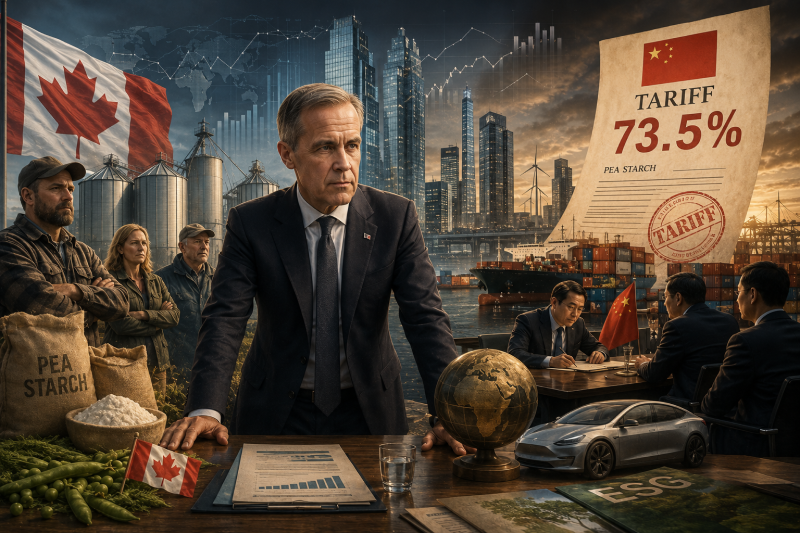
Mark Carney, Brookfield, and China’s 73.5% Pea Starch Tariff: Did Canada Lose Its Leverage?
China’s decision to impose a 73.5% preliminary anti-dumping tariff on Canadian pea starch is another warning sign that Canada’s trade relationship with Beijing remains unstable, unpredictable, and politically dangerous.
The measure takes effect on July 1, 2026, and follows a broader pattern of Chinese trade actions against Canadian agriculture, including previous pressure on canola, peas, pork, and aquatic products.
On paper, this is a technical anti-dumping case. In the real world, it looks like another chapter in a much larger struggle over leverage, access, retaliation, and political trust.
That is why the issue has quickly become tied to a bigger political question: did Prime Minister Mark Carney’s approach to China help Canada regain leverage, or did it expose Canadian exporters to a government that has repeatedly shown it is willing to use trade as a strategic weapon?
The Latest Blow: China Targets Canadian Pea Starch
China says Canadian pea starch was being dumped into its market and causing injury to domestic producers. As a result, importers of Canadian pea starch must now face a 73.5% provisional tariff or security deposit.
For Canadian agriculture, this matters because China is not just another customer. It is a massive market with the power to make or break export categories almost overnight.
When China moves against a Canadian commodity, the damage is rarely limited to one product. Farmers, processors, exporters, logistics companies, and investors all feel the pressure.
This Trade Fight Did Not Start With Pea Starch
The current dispute traces back to Canada’s 2024 decision to impose a 100% tariff on Chinese electric vehicles, along with duties on Chinese steel and aluminum. Canada argued that Chinese industrial overcapacity, state support, and unfair competition threatened Canadian industries.
China responded with investigations and retaliatory measures against Canadian exports. Agriculture became one of the easiest pressure points.
That pattern should not surprise anyone. When Beijing wants leverage, food and commodity exports are often the first place it applies pressure.
Canada Tried to Reset the Relationship
In early 2026, Canada moved toward a partial reset. Ottawa allowed up to 49,000 Chinese electric vehicles into the Canadian market at the standard 6.1% most-favoured-nation tariff rate, lifting the previous 100% surtax for that quota.
The hope was obvious: reduce tensions, open space for Chinese concessions, and improve Canadian access to the Chinese market.
But the new pea starch tariff shows the limits of that strategy. Even after Canada softened its EV position, China still moved forward with another major trade restriction against a Canadian agricultural product.
The Brookfield Question
Mark Carney’s past role at Brookfield Asset Management has added another layer of scrutiny to the issue.
Before entering the Prime Minister’s Office, Carney held senior roles at Brookfield, including work connected to ESG, climate finance, and impact investing. Brookfield has had major international investments, including exposure to China through real estate, infrastructure, energy, and finance.
Critics have focused on Brookfield’s Chinese investments, a reported refinancing arrangement involving the Bank of China, and Carney’s previous high-level engagement with Chinese officials and financial institutions.
None of this proves that Carney’s Brookfield history caused China’s latest trade action. That would be too strong a claim without direct evidence.
But it does raise a fair political concern: when a national leader has deep corporate history tied to global finance, China, ESG capital, and state-linked institutions, voters are entitled to ask whether Canada’s trade policy is being shaped from a position of strength or from a position of managed compromise.
Was This an ESG Mistake?
The phrase “ESG mistake” does not mean clean energy or sustainable finance are automatically bad. The issue is whether Canadian policymakers became too eager to believe that green finance diplomacy could soften China’s long-term strategic behaviour.
China is not simply a trade partner. It is a one-party state with a long planning horizon, state-backed industrial policy, and a history of linking commercial access to political pressure.
Canada may change governments. The United States may change presidents. Donald Trump may be tough one year and gone the next. But the Chinese Communist Party is not temporary in the same way democratic leaders are temporary.
That difference matters. Beijing can absorb short-term tension while pursuing long-term strategic advantage. Canada cannot afford to mistake temporary diplomatic warmth for permanent commercial security.
Did Canada Hand China Leverage?
The harshest criticism of Carney’s China strategy is that Canada gave something concrete — partial EV market access — while receiving only uncertain relief for Canadian exporters.
If China can accept concessions on EVs while still punishing Canadian agriculture, then Canada’s negotiating position deserves serious review.
Supporters of engagement will argue that diplomacy takes time, trade disputes are complicated, and keeping communication open with China is better than permanent confrontation.
That argument has some merit. Canada cannot simply ignore one of the world’s largest economies.
But engagement without leverage is not strategy. It is hope.
Canadian Farmers Are Paying the Price
The people most exposed to this dispute are not politicians, consultants, or global asset managers. They are Canadian farmers, processors, exporters, and workers who depend on stable market access.
When China imposes a tariff, Canadian producers do not get to debate theory. They deal with lost contracts, lower prices, uncertainty, and the urgent need to find replacement buyers.
This is why Canada needs a more disciplined trade strategy. Diversification cannot be a slogan. It has to become a real export policy that reduces dependence on politically risky markets.
What Canada Should Learn
Canada should not abandon trade with China. That would be unrealistic.
But Canada should stop treating China as a normal market governed only by commercial logic. Beijing’s trade actions often serve political, diplomatic, and strategic purposes.
That means Canada needs stronger leverage before making concessions, clearer protections for vulnerable sectors, and a serious plan to expand agricultural exports into alternative markets.
The lesson is simple: access to China can be profitable, but dependence on China can become dangerous.
Final Thoughts
China’s 73.5% tariff on Canadian pea starch is not just another trade headline. It is a stress test for Canada’s entire China strategy.
Mark Carney’s defenders will argue that he is trying to repair a difficult relationship and protect Canadian access to a major market. His critics will argue that his Brookfield background, ESG worldview, and willingness to soften Canada’s EV stance have left the country exposed.
The truth may be more complicated than either side wants to admit.
But one thing is clear: Canada cannot build its future on the assumption that China will reward goodwill with stability. In trade, leverage matters. And right now, Canadian agriculture is once again discovering what happens when that leverage is missing.