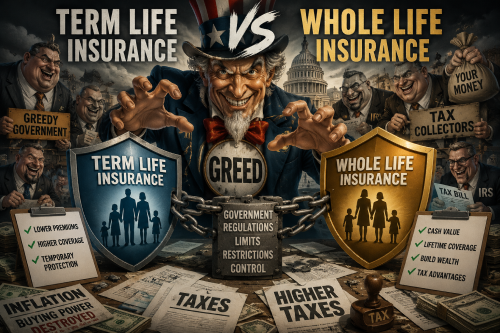
Whole Life Insurance vs. Term Life Insurance Is a Dumb Argument
The Real Problem Isn’t Whole Life or Term — It’s Government Restrictions
For years I’ve listened to one of the dumbest financial arguments imaginable:
“Term life insurance is better than whole life insurance.”
“No, whole life insurance is better than term insurance.”
It’s a goofy debate that completely misses the real issue.
The actual villain in this conversation is the government.
Because if we’re being honest, almost everybody wants cash value insurance they can borrow against.
Imagine if your auto insurance policy allowed you to build equity and borrow against it.
People would drain every dollar they could from those policies.
That’s why dividend-paying whole life insurance is attractive in the first place.
The problem isn’t that whole life insurance is bad.
The problem is the price tag.
Why Wealthy Families Buy Whole Life Insurance Early
People who understand the life insurance game usually buy permanent insurance as young as possible.
They buy policies for themselves early.
They buy policies for their children.
Why?
Because dividend-paying whole life insurance is dramatically cheaper when you’re young and healthy.
Most people discover whole life insurance too late.
By retirement age, many people are either:
Uninsurable
Extremely expensive to insure
Or dealing with health conditions that make large policies unrealistic
Term insurance has a massive weakness as you age.
Once the insurance company believes you’re statistically closer to death, premiums explode.
At some point the pricing becomes a message:
“We don’t really want you anymore.”
Because the insurance business is built around collecting premiums while paying out as little as possible.
That’s the uncomfortable truth.
Why Whole Life Insurance Actually Exists
The average person doesn’t understand why insurance companies allow policy loans.
It’s because the insurance company is operating with enormous pools of capital.
Your premiums become part of a much larger financial machine.
Life insurance is fundamentally a product designed to create financial security and transfer wealth efficiently.
That’s why wealthy families have used it for generations.
And contrary to what internet debates suggest, many people do not use whole life insurance primarily for dividends.
They use it like a private banking system.
The “Infinite Banking” Concept Explained Simply
When you borrow against a dividend-paying whole life insurance policy, you’re typically borrowing the insurance company’s money.
That distinction matters.
Why?
Because your policy’s cash value may continue compounding while you access liquidity through loans.

Once people understand compound interest, long-term policy growth, and multi-policy strategies, they start seeing why some wealthy individuals own numerous whole life policies alongside businesses, real estate, and investments.
That doesn’t automatically make whole life insurance superior for everyone.
It simply means the product has strategic uses.
Why “Buy Term and Invest the Difference” Isn’t Wrong
To be fair, for many people, term insurance is probably the safer and more practical option.
Buy term.
Invest the difference.
Fine.
There’s nothing inherently wrong with that strategy.
Especially for younger families trying to maximize protection with limited income.
But the debate becomes ridiculous when people act like one product should completely replace the other.
Different financial tools exist for different purposes.
The Real Problem: Government Limits and Currency Destruction
The real issue nobody wants to discuss is government interference.
Why should people be heavily restricted in how much capital they can place into life insurance structures?
That’s the real conversation.
Instead of endlessly arguing “whole life vs. term,” people should ask:
Why is the government involved at all?
Life insurance reduces financial dependency.
Families with strong insurance protection are less likely to become economic burdens later.
Yet governments simultaneously:
Restrict financial flexibility
Inflate currencies
Increase regulation
And reduce purchasing power over time
Meanwhile, your future death benefit buys less and less every decade due to inflation.
That’s the insanity.
Inflation Changes the Entire Conversation
Here’s what many financial debates ignore:
A million dollars today will not have the same purchasing power decades from now.
So when people argue over whether term or whole life is “better,” they’re often ignoring the bigger monetary problem entirely.
Currency debasement changes everything.
If someone wants a $50 million policy, why should politicians or regulators act like they know better than the insurer and the customer?
If an insurance company is willing to underwrite the risk, why should arbitrary limits exist?
Final Thoughts
Whole life insurance is not magical.
Term insurance is not evil.
Both products have strengths and weaknesses.
But the endless online arguments are mostly noise.
The bigger issue is financial freedom, inflation, government control, and whether individuals should have more flexibility in how they protect and structure wealth for future generations.
People need to stop treating complex financial tools like sports teams.
The conversation is far bigger than “whole life vs. term.”
It’s about control.