Abracadabra: Does It Really Come from Aramaic?
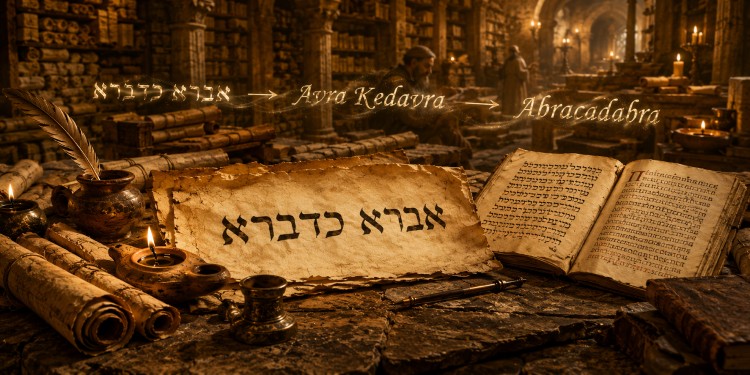
Few words are as instantly recognizable as "Abracadabra." For centuries it has been associated with magic, illusionists, and mysterious incantations. Yet many people have heard a fascinating claim: that the famous word actually originated from the ancient Aramaic phrase אברא כדברא (Avra kedavra), often translated as "I create as I speak."
Others have encountered a completely different explanation—that "Abracadabra" is a Hebrew acronym representing the Father, Son, and Holy Spirit.
So which explanation is correct?
The answer is more interesting than many people realize.
The Earliest Historical Evidence
The earliest known appearance of the word Abracadabra is not found in an ancient Hebrew or Aramaic manuscript.
Instead, it appears in a 2nd-century AD Latin medical text called Liber Medicinalis, written by the Roman physician Quintus Serenus Sammonicus.
The word was written repeatedly in a shrinking triangular pattern and was believed to possess protective or healing power.
For example:
ABRACADABRA
ABRACADABR
ABRACADAB
ABRACADA
ABRACAD
ABRACA
ABRAC
ABRA
ABR
AB
A
This is the earliest documented use that historians currently possess.
What remains unknown is where the word originally came from.
The Aramaic Theory
One of the most popular explanations is that Abracadabra originated from the Aramaic phrase:
אברא כדברא
Many people transliterate this into English as:
Avra kedavra
Avra k'davra
Abra kedabra
Abra qadabra
and translate it as:
"I create as I speak."
or
"I create according to my word."
The idea is certainly appealing.
It mirrors an ancient biblical concept that speech possesses creative power.
Genesis begins with:
"And God said, 'Let there be light.'"
Creation occurs through spoken words.
For this reason, the Aramaic explanation has become popular in discussions of biblical languages, mysticism, and Kabbalistic traditions.
However, it is important to distinguish between possibility and proof.
At present, no surviving ancient Aramaic manuscript has been discovered that explicitly identifies Abracadabra as originating from this phrase.
This means the Aramaic explanation remains a respected theory, but not an established historical fact.
The Hebrew Acronym Theory
Another explanation occasionally found online claims that Abracadabra is actually a Hebrew acronym representing:
Father
Son
Holy Spirit
This explanation is almost certainly not historical.
There are several reasons.
First, the doctrine of the Trinity developed within Christianity after the time of Jesus.
Second, Hebrew acronyms simply do not produce the word "Abracadabra" in any recognized historical way.
Finally, there are no ancient Hebrew sources connecting the word with such an acronym.
Most historians therefore regard this explanation as a much later religious interpretation rather than the true origin of the word.
Understanding Transliteration
One source of confusion is the way ancient languages are written.
The original Aramaic phrase appears as:
אברא כדברא
Those are Aramaic letters.
Most English speakers cannot read the Aramaic alphabet.
To help readers pronounce the words, scholars convert those letters into our alphabet.
This process is called transliteration.
Transliteration is not translation.
A translation conveys meaning.
A transliteration attempts to represent pronunciation.
Because there is no single perfect way to represent ancient sounds using English letters, you'll encounter several different spellings, including:

Avra
Abra
Abrah
kedavra
k'davra
qadabra
These are not different Aramaic words.
They are simply different attempts to represent the same sequence of Aramaic letters using different transliteration conventions.
In other words:
The original Aramaic text remains:
אברא כדברא
The Latin alphabet is only serving as a bridge to help readers approximate the pronunciation.
Why the Spellings Differ
Imagine asking five people to write the pronunciation of a foreign word they hear.
Each person might spell it slightly differently.
One writes:
Avra
Another writes:
Abra
A third writes:
Abrah
Yet all three may be trying to represent essentially the same sound.
This happens because English spelling was never designed to represent every sound found in ancient Semitic languages.
Different scholars also follow different transliteration systems.
None of these differences necessarily mean the underlying Aramaic word has changed.
Languages Naturally Evolve
Another important point is that languages constantly change.
Modern English sounds very different from English spoken 500 years ago.
English spoken 1,000 years ago is almost unrecognizable.
The same is true for every living language.
Latin evolved into:
Italian
Spanish
French
Portuguese
Romanian
Ancient Hebrew evolved into Modern Hebrew.
Ancient Aramaic evolved into several modern Neo-Aramaic dialects that are still spoken today.
Even names evolve.
Consider the name of Jesus.
In Hebrew and Aramaic it was:
יֵשׁוּעַ
(Yeshua)
When the New Testament was written in Greek, it became:
Ἰησοῦς
(Iēsous)
In Latin:
Iesus
Finally, in English:
Jesus
The name changed because every language adapted it to its own sounds and alphabet.
The same process explains why transliterations of Aramaic phrases can vary from one publication to another.
Why "Abracadabra" Sounds So Similar
Many people notice something remarkable.
Say these aloud:
Abracadabra
and
Avra kedavra
They undeniably sound similar.
This similarity is precisely why many researchers have proposed an Aramaic connection.
Whether that similarity reflects an actual historical origin or simply a later interpretation remains unknown.
At present, historians cannot prove either conclusion with certainty.
What Can We Say with Confidence?
Several facts are well established.
The earliest known written use of Abracadabra appears in a 2nd-century Latin text.
The ultimate origin of the word remains uncertain.
One respected theory connects it to the Aramaic phrase אברא כדברא, often translated as "I create as I speak."
No surviving ancient manuscript has yet confirmed that this phrase is the true historical origin of the magical word.
Different spellings such as Avra, Abra, kedavra, and qadabra are transliterations rather than different versions of the original Aramaic.
Perhaps the greatest lesson from this fascinating word is not merely its possible origin, but the incredible journey languages take over thousands of years. As words pass from one alphabet to another—from Aramaic to Greek, from Greek to Latin, and from Latin to English—they naturally change in spelling and pronunciation while often preserving echoes of their ancient past.
Whether or not Abracadabra ultimately proves to have Aramaic roots, it remains a remarkable example of how history, language, culture, and tradition can become intertwined in a single mysterious word.