
For us, politics is usually secondary to the money.
After all, democracy is democracy. People can vote for whoever they want. As long as elections are conducted fairly, voters ultimately get the governments they choose.
What interests us is what happens when the bills come due.
In our view, the United Kingdom, Canada, and Australia are all moving toward some form of austerity. Japan has been receiving much of the recent attention because of its long-running economic stagnation. To Japan's credit, it still manufactures a tremendous amount of goods and remains one of the world's most important industrial economies.
Yet even Japan experimented with the idea that immigration could solve its long-term economic problems. Increasingly, it appears that immigration alone is not the solution.
The bigger issue may be overregulation.
Some will argue the problem is government spending. We would argue the two are often connected. Governments regulate more, create larger bureaucracies, expand public obligations, and when tax revenues fail to keep pace, they borrow money to fill the gap.
Eventually, finance ministers are forced to confront an uncomfortable reality: tax collection alone may never be sufficient to pay down the debt.
Many economists respond by arguing that governments can simply print money. The problem is that countries still need real goods, real energy, and real production.
If you don't manufacture enough domestically, you become increasingly dependent on imports.
Japan illustrates this challenge well. The country imports much of its energy and has invested heavily in nuclear power. However, even nuclear infrastructure has limits. If electric vehicle mandates continue expanding globally, energy demand rises substantially, requiring even greater investment in generation capacity.
For manufacturing economies, energy policy becomes inseparable from economic policy.
The United Kingdom faces a different challenge.
Britain remains one of the world's leading financial centers. When a country that specializes in finance begins struggling with debt, deficits, and sluggish growth, investors tend to pay attention.
Which brings us to Keir Starmer.
Keir Starmer Steps Down
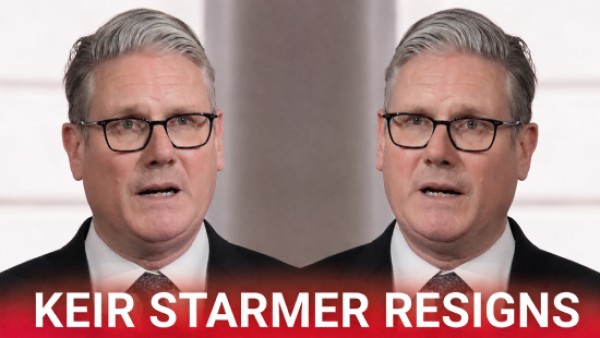
Keir Starmer has resigned as leader of the Labour Party and will, in time, leave office as prime minister.
Despite repeated promises that he would continue fighting for his leadership, pressure mounted following Andy Burnham's decisive victory in the Makerfield by-election. Eventually, the political math became impossible to ignore.
Starmer now becomes the sixth British prime minister in the past decade to leave office.
Reports suggest support within both Labour and his cabinet deteriorated significantly in recent weeks. Unlike the chaotic departures of Boris Johnson and Liz Truss, however, Starmer appears to be attempting a more orderly transition.
Even so, his resignation speech carried the unmistakable tone of a leader who understood that his political project had run out of road.
A Prime Minister Without A Honeymoon
Starmer entered Downing Street under unusual circumstances.
Before becoming prime minister, he already carried historically weak approval ratings. While Labour won a commanding parliamentary majority in 2024, public enthusiasm for Starmer himself remained relatively limited.

He received a brief post-election boost, but nothing comparable to the popularity enjoyed by Tony Blair in 1997 or even David Cameron in 2010.
His approval ratings improved temporarily before drifting back toward mediocrity.
In hindsight, the warning signs were visible early.
The Problem With Large Majorities
Political commentators often treat large parliamentary majorities as guarantees of stability.
Recent British history suggests otherwise.
Boris Johnson's government appeared politically untouchable following the Conservative landslide of 2019. Yet just a few years later, he was gone.
Starmer followed a similar path.
The reality is that winning an election and maintaining a coalition are two entirely different challenges.
Labour's 2024 victory was impressive on paper, but it was also built upon a fragmented political landscape. Labour secured a large majority while winning only a modest share of the overall vote.
That arrangement was always vulnerable to pressure from multiple directions.
Squeezed From Both Sides
Like Jeremy Corbyn before him, Starmer found himself trapped between competing voter groups.
Reform UK steadily chipped away at Labour's traditional working-class support, while the Green Party and independent candidates attracted progressive urban voters.
Labour found itself losing ground on both flanks.
The result was disappointing by-election performances, difficult local elections, and a growing sense that the governing coalition was becoming increasingly difficult to hold together.
The Debt Question
For investors and economists, however, the larger question extends beyond Starmer himself.
Whoever replaces him will inherit many of the same structural challenges.
Debt remains high.
Economic growth remains sluggish.
Public expectations remain expensive.
That combination rarely ends well.
This is where the conversation turns toward austerity.
Argentina made headlines by embracing severe spending reductions under Javier Milei. Whether one agrees with his policies or not, he was elected with a mandate to address a fiscal crisis directly.
The United Kingdom is not there yet.
British voters do not appear to be demanding austerity. Instead, they seem to be searching for better management of the country's finances.
The problem is that there may come a point where better management is no longer enough.
If the cupboards are empty, eventually someone has to acknowledge that reality.
That does not necessarily mean Britain faces an immediate crisis tomorrow morning. Economic decline often happens gradually. Canada, for example, has experienced recessionary conditions, yet many citizens would struggle to identify a dramatic change in their daily lives.
As the old analogy goes, when you slowly heat the water, the frog assumes everything is normal.
The question facing Britain, Canada, Australia, and several other developed economies is not whether difficult fiscal choices are coming.
The question is how long governments can delay making them.
For now, Keir Starmer's resignation may be remembered as a political story.
Years from now, historians may decide it was actually an economic one.