Updated September 5, 2026 All sources listed at the bottom of the article
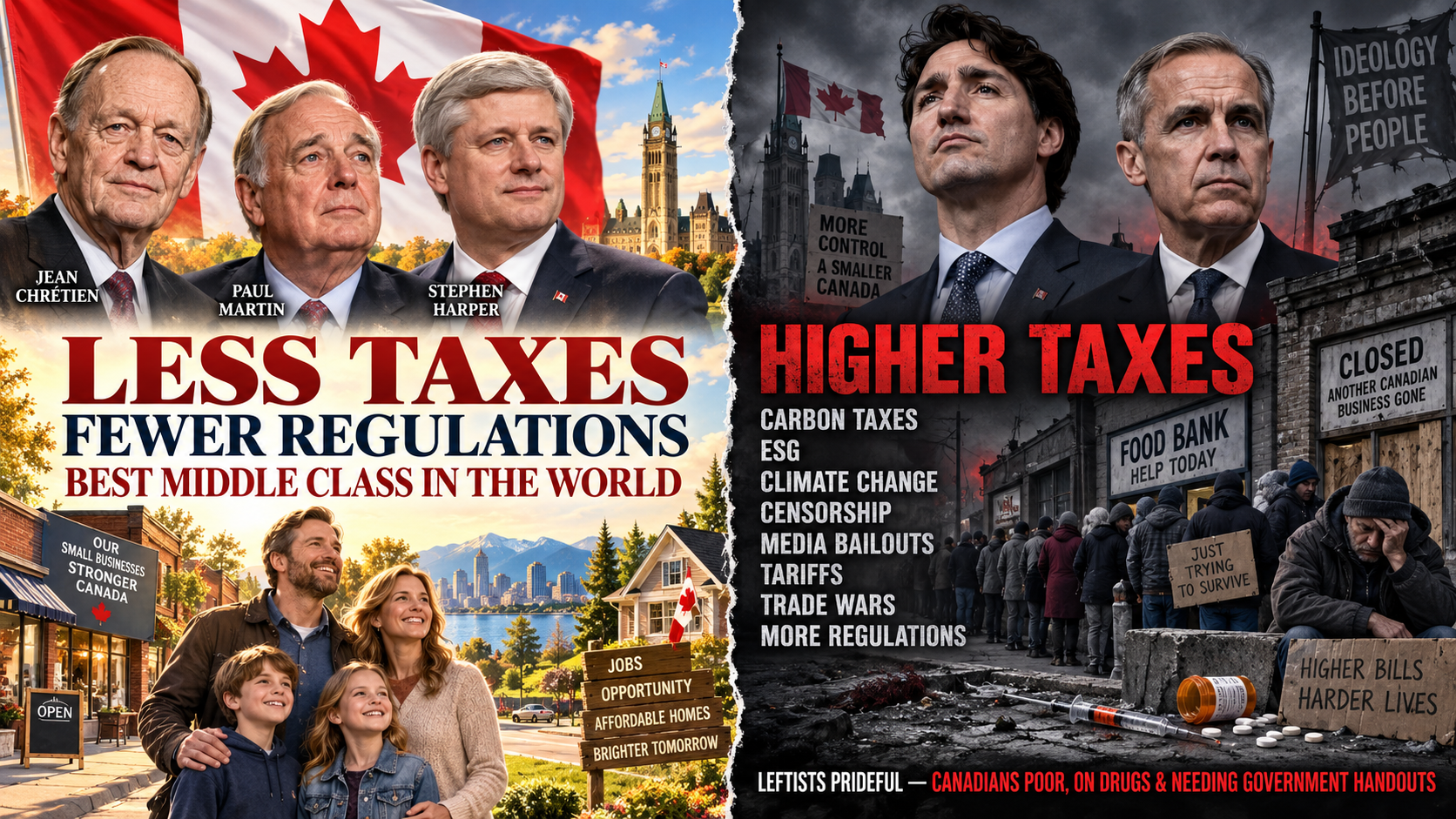
In 2014, Canada received an economic distinction that would sound almost unbelievable to many Canadian families today:
Canada's middle class had become arguably the wealthiest in the world.
A widely reported New York Times analysis using Luxembourg Income Study data concluded that median incomes in Canada had caught up with—and by some measures surpassed—those of the United States.
Canadian middle-income households had experienced substantial income growth while middle-class incomes in the United States had stagnated.
Then came the 2015 federal election.
Canadians replaced Stephen Harper's Conservative government with Justin Trudeau's Liberal government.
More than a decade later, Canada's economic position looks considerably different.
But if we're going to ask what happened to Canada's middle class, we shouldn't begin with a political conclusion and search for statistics that support it.
We should begin with the numbers.
And those numbers tell a more complicated—and ultimately more useful—story.
Was Canada's Middle Class Really the Richest in the World?
That's how the 2014 findings were widely described.
The New York Times analysis by David Leonhardt and Kevin Quealy examined international income data assembled through the Luxembourg Income Study Database.
The central finding was that Canada's median household income had caught up with the United States around 2010 after growing much more quickly during the previous decade.
Contemporary Canadian reporting summarized the conclusion even more directly:
Canada's middle class had become the world's most prosperous.
That doesn't mean every Canadian was wealthy.
It doesn't mean Canada had solved poverty.
And it doesn't mean Canadian households possessed more total wealth than everyone else.
The comparison concerned middle-income households and disposable income.
Canada's Rise Didn't Begin With Stephen Harper
This is where the political history becomes important.
It would be convenient for Conservatives to say Stephen Harper single-handedly created the conditions that produced Canada's prosperous middle class.
The historical record doesn't support such a simple explanation.
Canada's transformation occurred across governments led by both Conservatives and Liberals.
Brian Mulroney Began Major Structural Changes
Progressive Conservative Prime Minister Brian Mulroney pursued major economic restructuring during the 1980s and early 1990s.
His government implemented the Canada-U.S. Free Trade Agreement, privatized Crown corporations including Air Canada and Petro-Canada, reformed personal and business taxation and introduced the GST to replace the existing manufacturers' sales tax.
The GST itself was obviously a tax, so describing Mulroney simply as a tax cutter would be inaccurate.
His broader philosophy was restructuring Canada's tax system and increasing international competitiveness.
His government also began reducing corporate income-tax rates. A 1986 federal budget announced reductions in the basic federal corporate rate from 36% to 33%, manufacturing rates from 30% to 26%, and the small-business rate from 15% to 13%.
Then Liberal Governments Continued the Competitive-Tax Strategy
This is why the story cannot reasonably be reduced to Liberal versus Conservative.
Jean Chrétien's Liberal government and Finance Minister Paul Martin pursued deficit reduction and eventually major tax reductions.
Budget 2000 introduced a five-year tax-reduction plan.
The general federal corporate income-tax rate was scheduled to fall from 28% to 21%.
The government also restored full indexation of personal tax brackets, reduced the middle personal income-tax rate and reduced the capital-gains inclusion rate.
By 2005, Paul Martin's Liberal government was explicitly describing a competitive corporate tax system as important for investment, productivity, economic growth, wages and living standards.
This was a Liberal government making the argument that lower competitive business taxation could ultimately benefit Canadian workers.
Stephen Harper Continued the Same Broad Direction
Harper's Conservative government didn't invent this policy direction.
It accelerated it.
The GST was reduced from 7% to 6% in 2006 and eventually to 5%.
The general federal corporate income-tax rate continued falling until reaching 15% in 2012.
The federal capital tax and corporate surtax were eliminated, while other tax reductions were introduced for individuals and businesses.
By the early 2010s, Canada had developed an unusually competitive business-tax position among major developed economies.
Then, in 2014, came the famous international comparison of Canada's middle class.
So Did Canada's Middle Class Collapse Immediately After Trudeau?
No.
This is where the numbers force us to reject an overly convenient political narrative.
Statistics Canada's inflation-adjusted data show median after-tax income for families and unattached individuals at approximately:
- 2014: $66,800 in 2022 dollars
- 2015: $66,700
- 2016: $66,600
- 2017: $68,300
- 2018: $68,500
- 2019: $68,800
That's not a steep decline.
Real median after-tax income was initially stagnant and then increased modestly before the pandemic.
So anyone claiming that Canadian middle-class income immediately plunged when Justin Trudeau became prime minister would be overstating what the data show.
But Something Much More Concerning Happened Underneath
Income is only one measure of living standards.
A household cares about what its income can actually buy.
It cares about:
- Housing
- Food
- Transportation
- Taxes
- Debt payments
- Employment opportunities
- Wage growth
- Economic productivity
And when we examine Canada's broader economic performance, the post-2014 picture becomes considerably less flattering.
Canada's Real GDP Per Person Has Barely Grown
Statistics Canada's quality-of-life indicators provide one of the clearest measures.
Real GDP per capita, measured in 2017 chained dollars, was:
- 2015: $57,637
- 2019: $59,681
- 2022: $60,735
- 2023: $60,277
- 2024: $59,738
- 2025: $60,073
Think about what that means.
Over an entire decade, real economic output per Canadian increased only modestly.
Canada's total economy became much larger, but the population also became much larger.
For living standards, GDP per person often tells us more than celebrating total GDP growth.
The Business Investment Numbers Are Worse
This may be one of the most important statistics in the entire discussion.
The OECD reports that Canadian investment per worker in 2023 was only approximately 85% of its 2014 level.
Over the same period:
- U.S. investment per worker increased approximately 21%
- Euro-area investment per worker increased approximately 13%
- OECD investment per worker increased approximately 11%
Canada went backward.
Statistics Canada's own research reaches a similar conclusion: investment per worker in 2022 was nearly 20% below 2014 levels.
That matters enormously to the middle class.
Why Should Workers Care About Business Investment?
Because productivity ultimately determines how much an economy can sustainably pay its workers.
Imagine two employees performing the same job.
One has modern machinery, excellent software, automation and sophisticated equipment.
The other works with outdated equipment and inefficient systems.
The first worker can generally produce more economic value per hour.
That higher productivity creates room for higher wages without simply increasing prices.
When businesses stop investing in workers, machinery, technology and intellectual property, productivity suffers.
And weak productivity eventually becomes a middle-class problem.
Can We Blame Trudeau's Taxes and Regulations for All of This?
No.
Again, the evidence requires more nuance.
The OECD specifically identifies the end of the commodity supercycle around 2014 as an important cause of Canada's investment decline.
Investment in Canada's extraction industries had expanded dramatically before 2014 and then fell sharply as commodity conditions changed.
The pandemic subsequently caused another enormous economic disruption.
Global inflation, interest rates, supply-chain disruptions and geopolitical instability also affected Canada.
Those factors cannot reasonably be attributed exclusively to Justin Trudeau.
But that doesn't mean federal policy is irrelevant.
Canada Has Developed a Competitiveness Problem
Canada's own Competition Bureau now acknowledges this.
In 2026, the Bureau released research concluding that Canada had fallen behind peer countries in pro-competitive regulation.
It estimated that bringing Canadian regulatory competitiveness approximately in line with the United States could eventually increase GDP per capita by roughly 5%.
Matching leading international practices across the sectors studied could potentially increase productivity by approximately 10% over the long term.
The OECD likewise says Canada's regulatory environment is now more restrictive than its average, with comparatively high administrative burdens involving licensing and permitting.
That's not Conservative Party advertising.
Those conclusions come from Canada's Competition Bureau and the OECD.
Regulation Has a Cost Even When the Regulation Has a Purpose
This distinction matters.
A regulation can pursue a legitimate objective and still impose an economic cost.
Environmental regulations can reduce pollution.
Financial regulations can reduce systemic risk.
Labour regulations can protect workers.
Safety regulations can prevent injuries.
But compliance still requires:
- Employees
- Lawyers
- Consultants
- Reporting systems
- Permits
- Engineering
- Administration
- Time
The proper policy question isn't:
“Should Canada have regulations?”
Of course it should.
The question is:
“Are we achieving the regulatory objective at the lowest reasonable economic cost?”
The Trudeau Government Also Cut Some Middle-Class Taxes
Another fact that doesn't fit a simple partisan narrative:
One of Trudeau's first major tax changes was a middle-class income-tax cut.
The second federal personal income-tax bracket was reduced from 22% to 20.5% beginning in 2016.
At the same time, the government created a new 33% top federal tax bracket for higher-income Canadians.
So describing the Trudeau era as nothing but across-the-board personal tax increases would also be inaccurate.
But the Federal Government Became Much Larger
Federal spending provides another useful comparison.
Department of Finance figures show federal expenses were approximately 14.2% of GDP in 2014–15.
By 2024–25, they were approximately 17.8% of GDP.
The pandemic temporarily pushed that figure to approximately 29%, so using the 2020–21 number would dramatically exaggerate the structural change.
But even after pandemic programs largely disappeared, federal spending remained several percentage points of GDP above its 2014–15 level.
That represents a meaningful increase in the federal government's share of economic activity.
Then There's Carbon Pricing
Carbon pricing became one of the defining economic policies of the Trudeau era.
There were actually two important components:
Consumer fuel carbon pricing and industrial carbon pricing.
The consumer fuel charge has since been eliminated.
Industrial carbon pricing remains.
Prime Minister Mark Carney's government announced an updated industrial carbon-price trajectory in May 2026:
- 2026: $95 per tonne
- 2027: $100
- 2028: $100
- 2029: $100
- 2030: $115
- 2035: $130
- 2040: $140
The government's argument is that predictable industrial carbon pricing encourages investment in lower-emission technology while using output-based systems to protect competitiveness and limit carbon leakage.
Critics argue that carbon costs can still make Canadian manufacturing, resource development and other emissions-intensive industries less competitive.
Both concerns deserve examination.
Industrial Carbon Pricing Doesn't Stop at the Factory Gate
Businesses don't exist independently of households.
If an industrial producer faces higher costs, several things can happen.
The company can absorb the cost through lower profits.
It can improve efficiency.
It can invest in lower-emission technology.

It can reduce production
The Consumer Carbon Tax Ended, but Industrial Carbon Pricing Did Not
This distinction is important because discussions about Canada's carbon tax often combine two different policies.
Prime Minister Mark Carney's government eliminated the federal consumer fuel charge effective April 1, 2025.
That removed the federal carbon charge consumers had been paying directly on fuels such as gasoline and natural gas in provinces where the federal system applied.
But Canada did not eliminate carbon pricing.
The federal government retained the industrial side of the system—the Output-Based Pricing System (OBPS)—and continues to support carbon pricing for large industrial emitters.
That distinction matters enormously when discussing the middle class.
An industrial carbon price isn't normally presented to a family as a separate line item when they buy groceries, renovate a house or purchase manufactured goods.
Instead, the cost initially falls on regulated industrial facilities.
The economic question is what happens next.
Industrial Carbon Pricing Can Still Reach Consumers Indirectly
A tax or regulatory cost imposed upstream doesn't necessarily remain upstream.
A cement producer facing higher compliance costs can attempt to:
- Absorb the additional cost through lower margins
- Improve efficiency and reduce emissions
- Purchase compliance credits
- Invest in lower-carbon technology
- Reduce production
- Pass some portion of the cost to customers through higher prices
Which outcome occurs—and by how much—depends on the industry, competition, trade exposure, available technology and market conditions.
That's why it would be inaccurate to write that every dollar of industrial carbon pricing automatically becomes a dollar paid by Canadian households.
But it would be equally misleading to pretend that industrial taxes and regulatory compliance costs can never affect consumer prices, wages, investment or employment.
Businesses ultimately operate inside the same economy as households.
The Government's Own System Recognizes the Competitiveness Problem
Canada's industrial carbon-pricing framework doesn't simply charge every industrial facility the headline carbon price on every tonne it emits.
The Output-Based Pricing System uses performance standards and allows qualifying facilities to generate or purchase compliance units.
One reason for this design is to maintain an incentive to reduce emissions while limiting the risk that emissions-intensive, trade-exposed industries simply move production and investment to jurisdictions with weaker carbon constraints.
That risk is generally called carbon leakage.
This matters to the middle-class discussion because manufacturing competitiveness affects more than corporate profits.
It can affect:
- Employment
- Wages
- Business investment
- Domestic production
- Construction costs
- Consumer prices
- Exports
- The Canadian dollar
- The tax base supporting public services
Carney Has Chosen to Keep Industrial Carbon Pricing
Prime Minister Mark Carney therefore represents both continuity and change from Justin Trudeau's carbon-pricing policy.
The consumer fuel charge was eliminated.
Industrial carbon pricing remained.
Carney has argued that Canada should concentrate carbon pricing more heavily on large industrial emitters while attempting to preserve economic competitiveness and encourage investment in cleaner technology.
His government subsequently revised the federal industrial carbon-price trajectory rather than simply continuing every previously scheduled increase unchanged.
The current federal benchmark trajectory announced in 2026 is:
- 2026: $95 per tonne of CO2 equivalent
- 2027: $100
- 2028: $100
- 2029: $100
- 2030: $115
- 2035: $130
- 2040: $140
That is different from the previous trajectory under which the federal carbon-price benchmark had been scheduled to rise more rapidly toward $170 per tonne by 2030.
So describing Carney's policy simply as an uninterrupted continuation of Trudeau's carbon-tax schedule would be inaccurate.
But describing carbon pricing as having disappeared would also be inaccurate.
The direct consumer fuel charge disappeared; industrial carbon pricing survived.
Does Industrial Carbon Pricing Hurt the Middle Class?
This is where the article should resist an easy partisan answer.
Industrial carbon pricing can impose costs.
It can also create incentives for companies to use less energy, adopt cleaner technology and reduce emissions. If designed effectively, the system can potentially achieve environmental objectives without imposing the full headline carbon price on every unit of domestic production.
The relevant economic question isn't whether industrial carbon pricing has any cost.
Almost every major regulation has a cost.
The better questions are:
How large are those costs, who ultimately bears them, what benefits are produced in return, and how does Canada's approach affect its competitiveness relative to countries selling into the same Canadian market?
Consider Cement, Steel and Construction Materials
Cement provides a useful example because it is both emissions-intensive and fundamental to housing and infrastructure.
If Canadian cement producers face increasing carbon-compliance costs while competing against imported cement or concrete products manufactured under materially different carbon constraints, several outcomes are possible.
Canadian producers may become cleaner and more efficient.
They may develop technologies that ultimately provide a competitive advantage.
But if the cost difference becomes too large, domestic production could also lose market share to imports.
In that situation, Canada could lose industrial employment without necessarily reducing global emissions—the production simply occurs somewhere else.
Canada's own carbon-pricing framework acknowledges this risk, which is why emissions-intensive, trade-exposed industries receive special consideration.
Housing Makes This Especially Relevant to the Middle Class
The connection to middle-class living standards becomes clearer when industrial inputs flow into housing.
A house requires:
- Cement and concrete
- Steel
- Lumber
- Glass
- Insulation
- Transportation
- Heavy equipment
- Electricity
- Skilled labour
Carbon pricing isn't responsible for Canada's entire housing-affordability problem. Land restrictions, zoning, permitting delays, population growth, interest rates, labour shortages, development charges, material prices and many other factors matter.
But when governments say they want housing to become more affordable, every tax, fee and regulatory requirement affecting the cost of constructing that housing deserves scrutiny.
The relevant question should be empirical rather than ideological:
Does the environmental benefit produced by a particular policy justify its effect on the cost of producing the things Canadian households need?
The Same Standard Should Apply to Every Government
That brings us back to the historical point of this article.
This shouldn't be reduced to:
Conservative = low taxes and Liberal = high taxes.
Canadian history doesn't support such a simplistic rule.
Brian Mulroney's Progressive Conservative government introduced the GST—one of the most consequential federal taxes in modern Canadian history.
Jean Chrétien and Paul Martin's Liberal governments subsequently pursued major deficit reduction, restrained federal program spending and reduced several taxes while improving Canada's fiscal position.
Stephen Harper's Conservative government reduced the GST and corporate income-tax rate, while also increasing spending in other areas and running deficits following the global financial crisis.
Justin Trudeau's Liberal governments expanded transfers and benefits for many middle- and lower-income households while also increasing federal spending, introducing carbon pricing and expanding the federal government's regulatory and fiscal footprint.
Mark Carney has now eliminated one major consumer carbon charge while retaining industrial carbon pricing and pursuing his own combination of spending, taxation, tariffs and industrial policy.
The label attached to the government matters less than the result.
Are Canadian households becoming more productive, more prosperous and more capable of buying homes, raising families and accumulating wealth?
That's the standard against which the policy should ultimately be measured.
Sources & Further Reading
Canada's Middle Class and Income
- The New York Times — Canadians Have Plenty of Concerns, but Also a Sense They're Better Off
- Global News — Canada's Middle Class Richest in World: Report
- Statistics Canada — Median After-Tax Income, Market Income and Government Transfers, 2012–2022
GDP Per Capita, Productivity and Business Investment
- Statistics Canada — Quality of Life Indicator: Real GDP Per Capita
- Statistics Canada — Challenges and Opportunities in Innovation, Technology Adoption and Productivity
- OECD — Canada 2025: Raising Business-Sector Productivity
- OECD — Economic Surveys: Canada 2025 Full Report
- Department of Finance Canada — 2026 Productivity and Business Investment Briefing
Regulation and Canadian Competitiveness
Brian Mulroney-Era Tax Reform
Chrétien and Martin-Era Tax Policy
- Department of Finance Canada — 2000 Economic Statement and Five-Year Tax Reduction Plan
- Department of Finance Canada — 2005 Economic and Fiscal Update: Internationally Competitive Corporate Tax System
Stephen Harper-Era Tax Policy
- Government of Canada — GST Reduction to 5% and Other Federal Tax Changes
- Budget 2008 — Strengthening Canada's Tax Advantage
- Government of Canada — Federal General Corporate Income Tax Rate Reduced to 15% in 2012
- Budget 2012 — Improving Conditions for Business Investment
- Budget 2014 — Business Investment, Productivity and Federal Tax Reductions
Justin Trudeau-Era Middle-Class Tax Changes
- Department of Finance Canada — 2015 Middle Class Tax Cut Backgrounder
- Budget 2016 — Help for the Middle Class
Federal Spending
Consumer and Industrial Carbon Pricing
- Department of Finance Canada — Removal of the Federal Consumer Carbon Price Effective April 1, 2025
- Canada Revenue Agency — Historical Federal Fuel Charge Rates and Removal of the Fuel Charge
- Environment and Climate Change Canada — Carbon Pricing Systems Across Canada
- Environment and Climate Change Canada — Federal Carbon Pollution Pricing Benchmark and 2026–2040 Industrial Price Trajectory
Canada-U.S. Tariffs and Counter-Tariffs
- Department of Finance Canada — Canada's Response to U.S. Tariffs
- Department of Finance Canada — Canada's 2026 Countermeasures in Response to U.S. Tariffs
- Department of Finance Canada — U.S. Products Subject to Canadian Counter-Tariffs Effective September 8, 2026
- Department of Finance Canada — Tariff Remission for U.S. Goods and Canadian Business Inputs