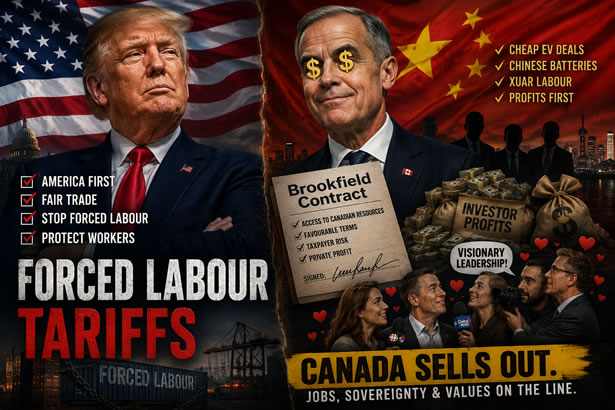

Donald Trump's Forced-Labour Tariffs and Mark Carney's EV-China Dilemma
The growing trade dispute between the United States and several of its trading partners is increasingly focused on one issue: forced labour within global supply chains.
The Trump administration recently proposed new tariffs on more than 60 countries, including Canada, arguing that many nations have failed to adequately prevent goods linked to forced labour from entering North American markets.
At the same time, Canada is moving in a different direction when it comes to electric vehicles.
Following discussions between Prime Minister Mark Carney and Chinese officials earlier this year, Canada agreed to allow up to 49,000 Chinese-made electric vehicles into the country annually under a significantly reduced tariff rate.
The Supply Chain Question
The debate extends far beyond finished automobiles.
Many of the world's electric vehicle batteries rely on critical minerals such as lithium, cobalt, nickel, and graphite. Human-rights organizations, governments, and industry researchers have raised concerns about portions of these supply chains.
Particular attention has focused on China's Xinjiang Uyghur Autonomous Region (XUAR), where state labour-transfer programs have been criticized by Western governments and human-rights groups. Several companies connected to critical-mineral processing have faced sanctions and restrictions under U.S. law.
Concerns have also been raised regarding child labour associated with cobalt mining operations in the Democratic Republic of the Congo, another key source of materials used in electric vehicle batteries.
Canada's EV Strategy
Supporters of Canada's decision to allow additional Chinese-made electric vehicles argue that increased competition will lower prices for consumers and accelerate EV adoption.
Industry advocates have suggested that more competition could place downward pressure on vehicle costs and make electric transportation more affordable for Canadian households.
Critics, however, argue that the policy creates challenges for Canada's domestic automotive sector while potentially increasing exposure to supply chains that remain under scrutiny internationally. Canada's major automakers have warned that increased Chinese imports could undermine domestic manufacturing and raise additional concerns regarding technology and supply-chain security.
Trump's Tariff Argument
The Trump administration's position is straightforward: countries that fail to sufficiently prevent goods linked to forced labour from entering supply chains should face economic consequences.
U.S. Trade Representative Jamieson Greer recently argued that trading partners have not done enough to address the importation of goods connected to forced labour concerns. As a result, new tariffs have been proposed against dozens of countries, including Canada.
Whether these tariffs ultimately take effect remains uncertain, as the proposals must still go through hearings, public consultation, and review processes.
The Bigger Issue
The larger question for investors, policymakers, and consumers is whether modern supply chains can realistically separate themselves from regions and industries facing human-rights allegations while still maintaining affordable prices.
Electric vehicles, solar panels, batteries, and numerous consumer products increasingly rely on global supply networks that stretch across multiple countries and jurisdictions.
As governments pursue climate goals, industrial policy, and economic growth, questions surrounding labour standards and supply-chain transparency are becoming more difficult to ignore.
Final Thoughts
The emerging disagreement between Donald Trump's proposed forced-labour tariffs and Canada's EV import strategy highlights a broader challenge facing Western economies.
On one side is the desire for lower prices, increased competition, and faster adoption of electric vehicles. On the other is growing scrutiny of the global supply chains that make those products possible.
Regardless of where the debate ultimately lands, supply-chain transparency is becoming one of the most important economic and political issues of the decade.