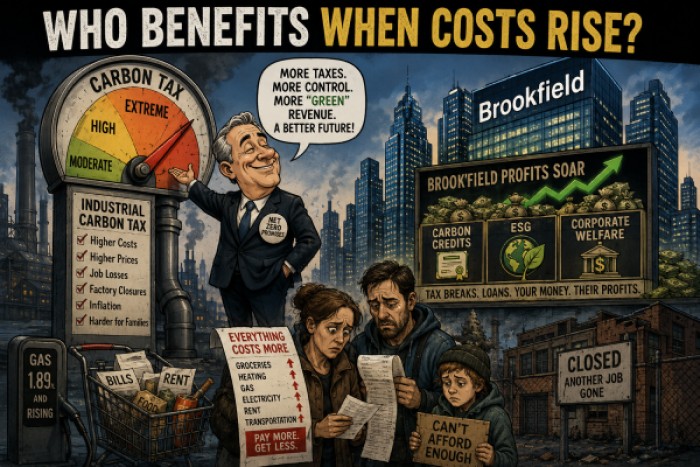
Canadian Prime Minister Mark Carney's Carbon Tax Drives Inflation To Its Highest Level Since 2023 (June 22, 2026)
Canada's inflation rate climbed to 3.2 per cent in May, its highest level since late 2023, and while much of the media is focusing on Middle East tensions and higher oil prices, there is another factor that deserves attention: Canada's industrial carbon tax system.
Supporters argue that industrial carbon pricing encourages businesses to reduce emissions and invest in cleaner technologies. Critics argue it functions as an additional cost layered onto energy production, transportation, manufacturing, and food production, ultimately finding its way into consumer prices.
The federal government recently confirmed a new industrial carbon pricing schedule that starts at $95 per tonne in 2026 and gradually rises to $140 per tonne by 2040. The policy, strongly associated with Prime Minister Mark Carney's climate agenda, applies to large industrial emitters across much of the country.
The timing is notable.
Statistics Canada reported that inflation accelerated from 2.8 per cent to 3.2 per cent in May. Grocery inflation climbed to 4.3 per cent, while fresh vegetables posted their largest May increase since 2008. Transportation costs, airline prices, and fuel-related expenses also moved higher.
While economists point to the Iran conflict and temporary disruptions to global energy markets, critics of Canada's climate policies argue that domestic energy costs were already elevated before those events occurred.
The argument is relatively simple.
Energy affects transportation.

Transportation affects food.
Food affects household budgets.
Every additional cost imposed on energy-intensive industries eventually works its way through the economy.
This is why some analysts believe Canada's inflation problem is not entirely imported. Instead, they argue that part of the price pressure is self-inflicted through domestic energy and regulatory policies.
The broader concern is economic growth.
Canada recently entered what many economists describe as a "technical recession." While the average Canadian may not feel dramatic economic pain today, growth has slowed, productivity remains weak, and household affordability continues to deteriorate.
Supporters of industrial carbon pricing argue that these policies are necessary to reduce emissions and attract long-term clean-energy investment. Critics counter that Canada is imposing California-style energy costs without possessing California's wealth base.
For comparison, California alone has more millionaires than all of Canada combined and roughly three times as many billionaires. Critics argue that wealthy jurisdictions are better positioned to absorb higher energy and regulatory costs than countries already struggling with stagnant productivity and weak economic growth.
The larger question for investors and policymakers is whether Canada's climate policies are helping the economy transition toward future growth—or simply increasing costs during a period of economic weakness.
As inflation rises and recession concerns persist, that debate is unlikely to disappear anytime soon.