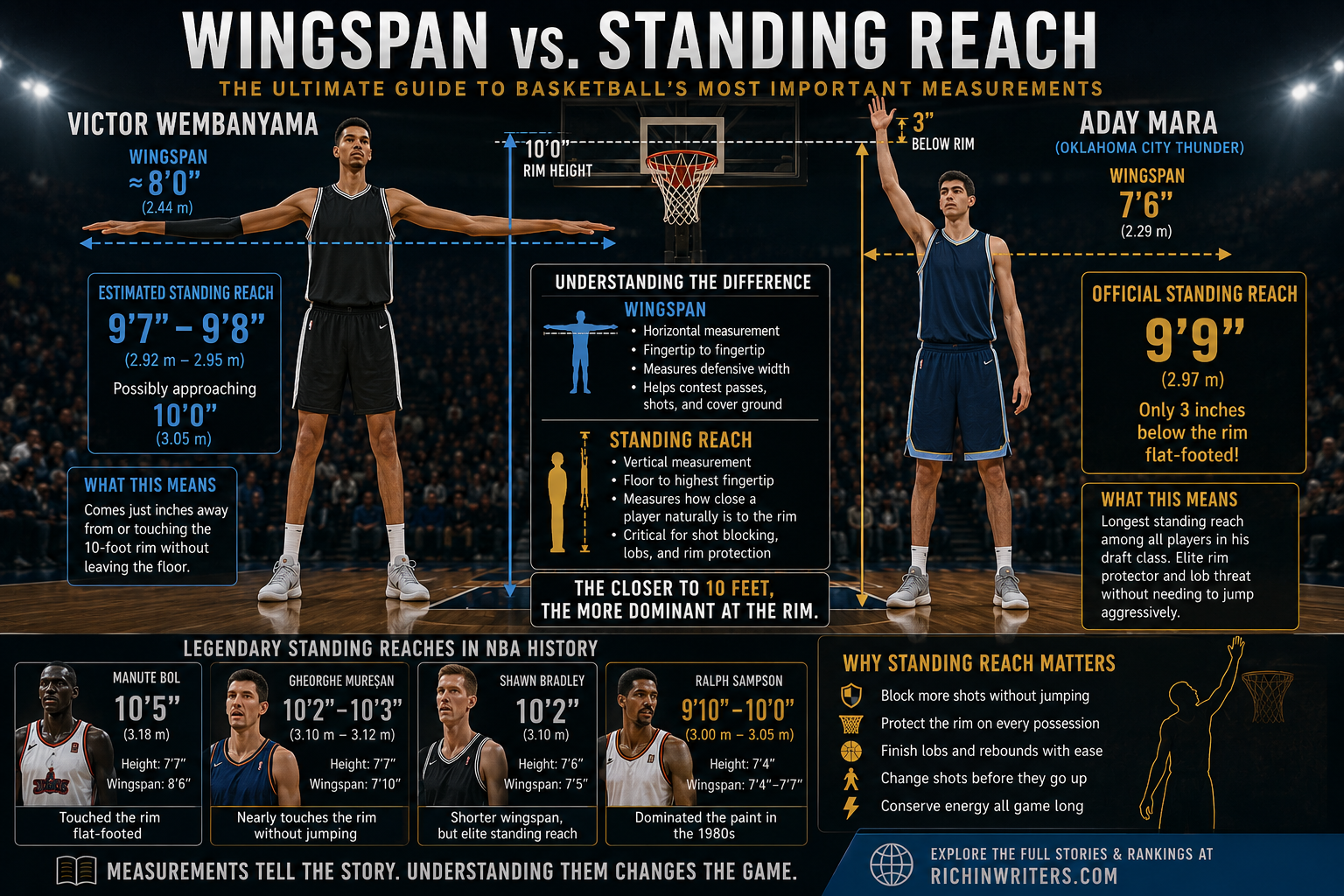

The Greatest Standing Reaches in Basketball History (Ranked)
Introduction
When basketball fans discuss freakish physical gifts, most conversations begin and end with height or wingspan.
But NBA scouts often pay just as much attention to another measurement that may be even more important for centers and shot blockers:
Standing Reach.
Standing reach measures how high a player's fingertips extend while standing flat-footed with one arm raised overhead.
Unlike vertical leap, standing reach never disappears.
It affects every rebound, every shot contest, every lob catch, and every blocked shot.
Some players can nearly touch—or even touch—the rim without jumping.
Below are the greatest standing reaches basketball has ever seen.
How We Ranked Them
Whenever possible we used official NBA Draft Combine measurements.
For historical players whose official combine measurements do not exist, we relied on widely accepted measurements documented by NBA historians, scouts, and basketball analysts.
Estimated measurements are clearly identified.
1. Manute Bol
Standing Reach
10 feet 5 inches (Approximate)
Height
7'7"
Wingspan
8'6"
Few players in basketball history possessed physical dimensions comparable to Manute Bol.
His standing reach is widely estimated at approximately 10 feet 5 inches, meaning he could touch the rim while standing completely flat-footed.
His 8-foot-6 wingspan remains one of the longest ever recorded.
Perhaps even more incredible, Bol's wingspan measured roughly 11 inches longer than his height, making him one of the greatest physical anomalies basketball has ever seen.
2. Gheorghe Mureșan
Standing Reach
Estimated 10'2"–10'3"
Height
7'7"
Wingspan
Approximately 7'10"
Tied as the tallest player in NBA history, Mureșan naturally possessed one of basketball's greatest standing reaches.
Without jumping, he could nearly touch the rim.
His sheer size allowed him to dominate the paint despite not being the most explosive athlete.
3. Shawn Bradley
Standing Reach
Approximately 10'2"
Height
7'6"
Wingspan
7'5"
Shawn Bradley proves that wingspan alone does not determine standing reach.
Although his wingspan was actually slightly shorter than his height, his towering frame still produced one of the greatest standing reaches ever measured.
That reach helped him become one of the NBA's greatest shot blockers.
4. Ralph Sampson
Standing Reach
Estimated 9'10"–10'0"
Height
7'4"
Wingspan
Estimated 7'4"–7'7"
Before modern NBA unicorns existed, Ralph Sampson represented basketball's future.
His standing reach approached ten feet, allowing him to finish around the basket with minimal effort while altering countless shots defensively.
5. Victor Wembanyama
Standing Reach
Estimated 9'7"–9'8"
(Some analysts now believe it could be approaching 10 feet.)
Height
Approximately 7'5" (in shoes)
Wingspan
Approximately 8'0"
Because Wembanyama skipped the NBA Draft Combine, no official standing reach exists.
Most estimates place his standing reach between 9 feet 7 inches and 9 feet 8 inches, though continued growth has led many observers to speculate it may now be even higher.
His standing reach explains why his block radius feels almost unfair.
Even without jumping, Wembanyama already begins just inches below the rim.
6. Aday Mara
Standing Reach
Official: 9'9"
Height
7'3"
Wingspan
7'6"
Among modern NBA Draft Combine measurements, Aday Mara produced one of the most impressive standing reaches ever officially recorded.
His 9-foot-9 standing reach ranked as the longest in his draft class.
Combined with his massive frame, Mara projects as an elite rim protector and lob threat because he starts every possession only three inches below the rim.
Why Standing Reach Matters More Than Vertical Leap
Many fans assume elite shot blockers rely primarily on vertical jumping ability.
The reality is often the opposite.
Standing reach determines how close a defender already is to the basket before leaving the floor.
A player with a 10-foot standing reach barely needs to jump to block shots that would be unreachable for shorter defenders.
That saves energy over the course of a game while dramatically increasing defensive efficiency.
Standing Reach vs Wingspan
Although closely related, these measurements are completely different.
| Standing Reach | Wingspan |
|---|---|
| Vertical measurement | Horizontal measurement |
| Floor to highest fingertip | Fingertip to fingertip |
| Determines rim proximity | Determines lateral coverage |
| Helps block shots | Helps contest passes and steals |
| Most valuable near the basket | Most valuable across the court |
If you'd like a detailed explanation of these two measurements, be sure to read our companion guide:
Wingspan vs. Standing Reach: What's the Difference?
Greatest Standing Reach Comparison
| Player | Height | Wingspan | Standing Reach |
| Manute Bol | 7'7" | 8'6" | 10'5" (Approx.) |
| Gheorghe Mureșan | 7'7" | 7'10" | 10'2"–10'3" |
| Shawn Bradley | 7'6" | 7'5" | 10'2" |
| Ralph Sampson | 7'4" | 7'4"–7'7" | 9'10"–10'0" |
| Aday Mara | 7'3" | 7'6" | 9'9" (Official) |
| Victor Wembanyama | Approx. 7'5" | Approx. 8'0" | Estimated 9'7"–9'8" |
Final Thoughts
Standing reach remains one of the most overlooked measurements in basketball.
While fans naturally gravitate toward vertical leap and wingspan, NBA executives understand that standing reach often tells the better story.
It determines how close a player already is to the basket before jumping.
Whether it's Manute Bol's astonishing 10-foot-5 standing reach, Shawn Bradley's elite rim protection, Gheorghe Mureșan's incredible height, Ralph Sampson's revolutionary size, Victor Wembanyama's estimated near-rim reach, or Aday Mara's officially measured 9-foot-9 standing reach, each player demonstrates why standing reach has become one of basketball's most valuable scouting measurements.
As player development continues to evolve, standing reach will likely remain one of the first numbers NBA scouts examine when evaluating the next generation of elite centers.