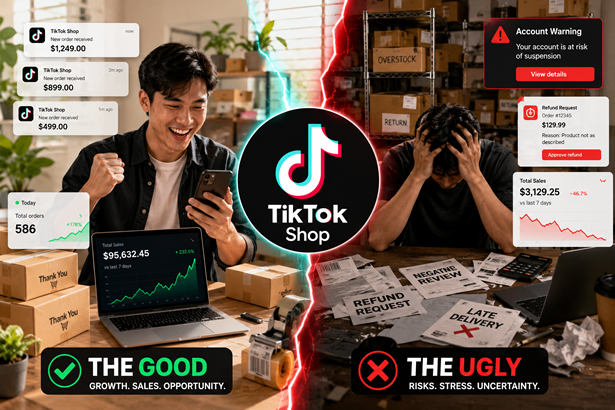

TikTok Shop has become one of the fastest-growing ecommerce platforms in the world. Thanks to TikTok's massive user base and powerful recommendation algorithm, entrepreneurs can now place products directly in front of millions of potential customers without building a large audience first.
The success stories are everywhere. Sellers post screenshots showing thousands of dollars in daily sales. Influencers talk about products going viral overnight. Affiliates claim they are generating commissions while they sleep.
But behind the excitement lies a reality many newcomers fail to understand: generating sales and generating profits are two completely different things.
Before you invest money into inventory, creators, advertising, or product development, it's worth examining the good, the bad, and the ugly side of TikTok Shop.
The Good: Why Entrepreneurs Love TikTok Shop
1. Massive Organic Reach
Unlike traditional ecommerce platforms that often require expensive advertising, TikTok allows products to gain exposure through its recommendation engine. A single video can generate thousands or even millions of views regardless of how many followers the creator has.
This creates opportunities for small businesses to compete against larger brands without enormous marketing budgets.
2. Built-In Purchasing
TikTok Shop allows users to purchase products directly within the app. This reduces friction during the buying process because customers don't need to leave TikTok and visit a separate website.
Fewer steps often result in higher conversion rates.
3. Powerful Affiliate Ecosystem
One of TikTok Shop's biggest advantages is its affiliate network. Businesses can recruit creators who promote products in exchange for commissions.
This allows sellers to leverage the audiences and content creation skills of other people instead of relying entirely on their own marketing efforts.
4. Lower Startup Barriers
Compared to opening a retail store or launching a large ecommerce operation, TikTok Shop can be started with relatively modest capital.
Many sellers begin by testing products before committing significant resources.
5. Excellent for Demonstration Products
Products that can be demonstrated visually often perform exceptionally well. Kitchen gadgets, beauty products, fitness accessories, home organization tools, and novelty items frequently benefit from TikTok's video-first format.
The Bad: Challenges Many Sellers Underestimate
1. Constant Content Creation
TikTok rewards consistency. Sellers often discover that one successful video isn't enough.
Many businesses must continually create fresh content, test new angles, and work with multiple creators to maintain momentum.
For entrepreneurs who dislike content marketing, this can become exhausting.
2. Heavy Dependence on the Algorithm
Your business can experience dramatic swings in visibility based on algorithm changes and user engagement patterns.
A product generating strong sales today may see traffic disappear tomorrow without warning.
3. Thin Profit Margins
Many sellers focus heavily on revenue numbers while ignoring the actual costs involved.
Expenses can include:
- Inventory
- Shipping
- Packaging
- Returns
- Creator commissions
- Advertising
- Customer service
- Software subscriptions
A product generating significant revenue may still produce very little profit.
4. Inventory Risk
Successful TikTok sellers often face a difficult balancing act.
Order too much inventory and you risk being stuck with unsold products.
Order too little inventory and you risk running out of stock when demand spikes.
Inventory management becomes increasingly difficult as sales volume grows.
5. Customer Service and Fulfillment
Every sale creates operational responsibilities.
Returns, shipping delays, damaged products, customer complaints, and refund requests can consume significant amounts of time and resources.
The Ugly: Risks Nobody Talks About
1. Viral Success Can Become a Problem
Most entrepreneurs dream about going viral.
Ironically, viral success can damage a business if operations are not prepared.
Sudden demand spikes can overwhelm inventory systems, customer support teams, suppliers, and fulfillment operations.
What looks like a blessing can quickly become a nightmare.
2. Copycats Move Fast
If a product performs well, competitors notice.
Popular products are often copied quickly by competitors who attempt to undercut pricing or imitate marketing strategies.
In some cases, sellers find themselves competing against dozens of nearly identical offers within weeks.
3. Platform Dependency
Building an entire business around a single platform carries risk.
Account restrictions, policy changes, algorithm adjustments, or platform disruptions can have significant consequences.
Entrepreneurs who rely exclusively on TikTok Shop may find themselves vulnerable if circumstances change.
4. Trend-Based Businesses Can Collapse Quickly
Many TikTok products succeed because they become trendy.
The problem is that trends eventually fade.
Businesses built entirely around temporary trends often struggle to maintain long-term stability.
5. Race-to-the-Bottom Pricing
As competition increases, sellers frequently lower prices to remain competitive.
Over time, this can reduce margins and make profitability increasingly difficult.
Winning sales does not always mean winning financially.
The Profitability Myth
One of the most common misconceptions surrounding TikTok Shop is the belief that sales automatically equal success.
Many entrepreneurs celebrate revenue milestones while ignoring the costs required to generate those sales.
Experienced marketers understand concepts such as:
- Product-market fit
- Customer acquisition costs
- Gross margins
- Contribution margins
- Lifetime customer value
- Testing and optimization
This does not mean beginners cannot succeed.
However, experienced marketers often have an advantage because they understand how to evaluate whether a business is actually profitable.
Depending on inventory investments, creator partnerships, advertising expenses, and operational costs, some sellers may require weeks or even months before reaching break-even.
Viral success is possible, but it should never be treated as a business plan.
Who Should Consider TikTok Shop?
- Brand owners with unique products
- Manufacturers looking for direct sales channels
- Content creators with engaged audiences
- Marketers experienced in testing and optimization
- Businesses seeking additional customer acquisition channels
Who Should Be Careful?
- Entrepreneurs with very limited capital
- Businesses operating on thin margins
- People expecting instant profits
- Sellers who dislike content creation
- Businesses relying on a single product or trend
Final Thoughts
TikTok Shop can be a powerful platform for generating sales and acquiring customers. For some businesses, it has created opportunities that did not exist just a few years ago.
However, the reality is more complicated than many influencers suggest.
The platform rewards creativity, consistency, testing, and operational discipline. While beginners can absolutely succeed, many underestimate the amount of patience, capital, and business knowledge required to become consistently profitable.
If you're considering TikTok Shop, focus less on viral success stories and more on building a sustainable business model.
At the end of the day, revenue is exciting, but profit is what keeps a business alive.