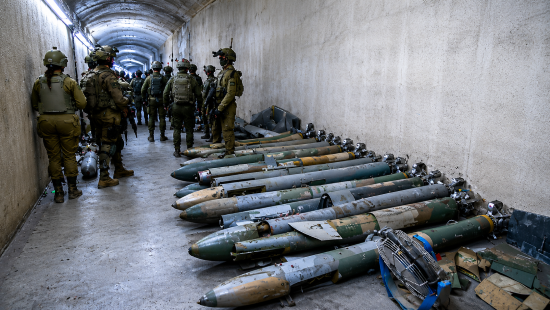

Money And War: IDF Captures Hezbollah Drone Factory And Launch Site Inside South Lebanon Mountain
Current President Donald Trump often speaks in a cryptic style that leaves many observers wondering what message he is trying to convey. While Trump frequently talks about making deals or negotiating with Iran, the reality may be far more practical: replenishing America's advanced weapons stockpiles in an economically efficient manner.
If you've been listening to Trump lately, some of his comments may seem difficult to follow. What does make sense, however, is the growing number of reports showing that the United States faces shortages of certain advanced weapons systems, particularly missile-defense interceptors and precision-guided munitions, after years of military assistance abroad and operations throughout the Middle East.
While the U.S. military maintains more than enough capability for current combat scenarios, rebuilding inventories of highly specialized weapons can take years. Advanced weapons are not products that simply roll off an assembly line. They are complex, expensive systems that require significant time and resources to manufacture.
This reality helps explain why the debate over military spending is often more complicated than it appears. Critics frequently ask why so much money is devoted to defense, but modern warfare relies heavily on technology that is costly to develop and replace.
From our perspective, Trump's calculations appear to involve both military realities and political messaging. Casualties are never desirable for any administration, and the use of advanced military assets creates pressure to replenish stockpiles while maintaining public support.
Recent developments in Lebanon may provide some context.
Israeli military officials say they have uncovered and seized a sophisticated underground Hezbollah drone facility near the village of Majdal Zoun in southern Lebanon, only a few kilometers from the Israeli border.
According to the Israel Defense Forces (IDF), the tunnel complex was built with Iranian planning and financial support over the past decade. Officials say the site functioned as both a drone factory and launch base used to assemble, store, and deploy unmanned aerial vehicles toward Israel.
Israeli forces reportedly discovered approximately 50 drones, large quantities of explosives, launch shafts protected by blast doors, and underground passageways extending hundreds of meters beneath the mountain. Military officials described the facility as one of the most sophisticated Hezbollah tunnel systems discovered to date.
The tunnel was reportedly captured during recent operations in southern Lebanon and is expected to be demolished after intelligence gathering and engineering assessments are completed.
For those trying to understand Trump's rhetoric regarding Iran and its regional proxies, discoveries such as this may be part of the broader picture. The assumption being made by some analysts is that weakening Iranian-backed proxy groups reduces future threats while limiting the need for larger military commitments later.
The debate, however, continues over how these objectives should be achieved. Critics argue that air campaigns risk unintended casualties, while supporters contend that targeting military infrastructure reduces long-term threats without requiring large-scale ground invasions.
Beyond military matters, Trump has consistently promoted greater American access to energy markets. The challenge is that many private companies remain hesitant to invest heavily in politically unstable regions. Extracting resources from hostile areas requires security, infrastructure, and profitability. Simply saying "we'll take the oil" is far easier than executing such a strategy in practice.
From a business perspective, Trump often appears to be asking a basic question: what strategic value does the United States receive from its involvement in various global conflicts?
Whether one agrees with that assessment or not, recent military operations suggest that American policy continues to be guided by a mixture of national security concerns, energy interests, economic considerations, and geopolitical realities.
For Israel, the discovery of the Hezbollah drone facility represents a significant intelligence and military success. Whether it ultimately changes the broader strategic picture remains to be seen, but it provides a clearer look at the infrastructure that has been built along Israel's northern border over the past decade.