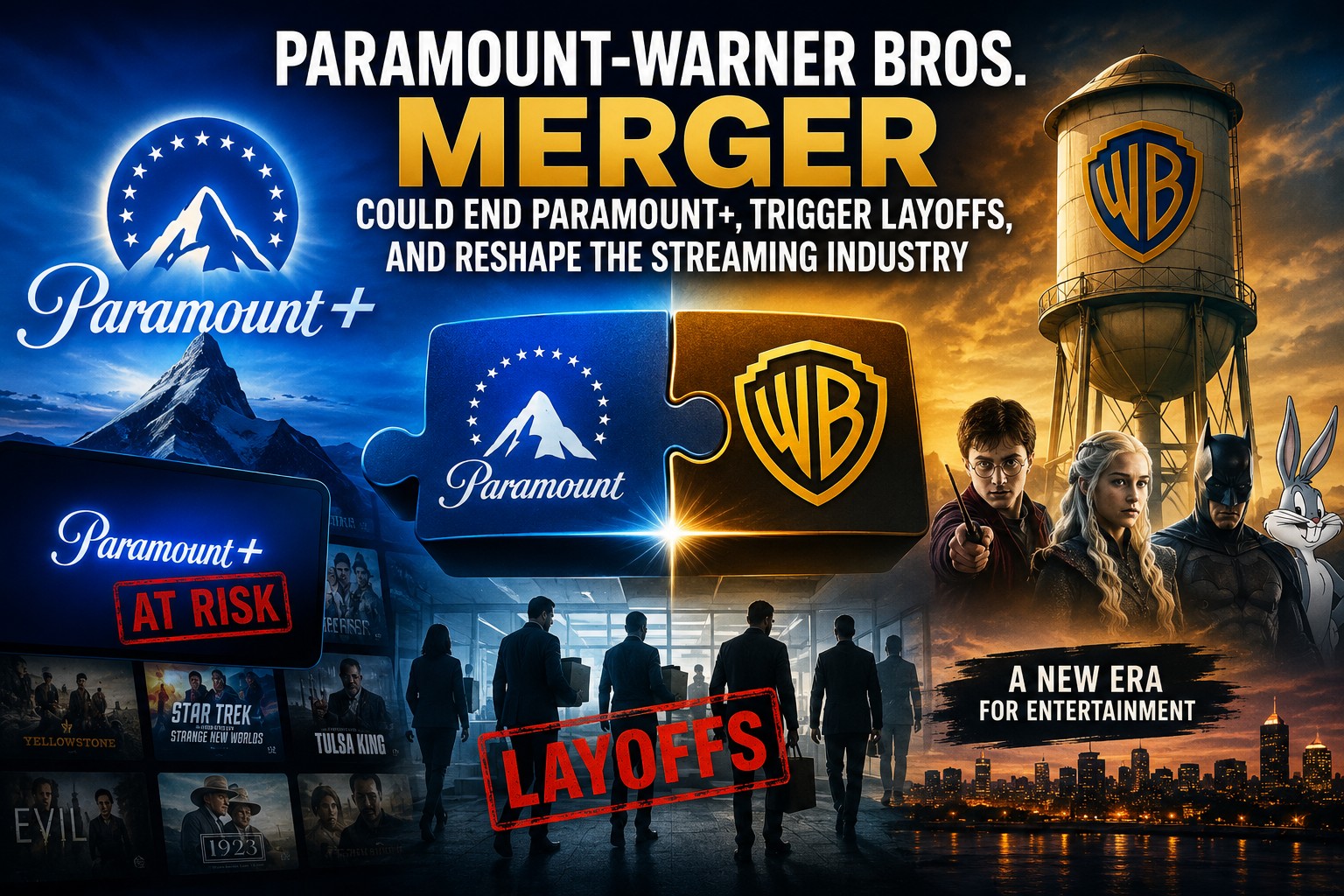
Paramount-Warner Bros. Merger Could End Paramount+, Trigger Layoffs, and Reshape the Streaming Industry
The entertainment industry may be on the verge of one of the most significant transformations in modern Hollywood history.
The proposed $110 billion merger involving Paramount, Skydance Media, and Warner Bros. Discovery would create one of the largest media companies in the world, combining some of the industry's most recognizable brands under a single corporate umbrella.
While supporters argue the merger will create a stronger competitor to streaming giants like Netflix and Amazon, critics warn that consumers could face fewer choices, fewer theatrical releases, and a wave of layoffs across the entertainment sector.
Paramount+ May Disappear
One of the most immediate impacts for consumers could be the eventual disappearance of Paramount+ as a standalone streaming service.
Industry analysts expect the merged company to combine assets from Paramount+ and HBO Max into a single streaming platform designed to compete directly with Netflix.
While HBO's brand recognition remains exceptionally strong, Paramount+ has struggled to establish itself as a must-have streaming service despite years of growth and investment.
As a result, many observers believe HBO Max will survive as the primary consumer-facing brand, while Paramount+ content becomes integrated into a larger platform.
For subscribers, this could mean fewer standalone streaming options but potentially a larger content library under one subscription.
Netflix Is Reportedly Fighting Back
The merger is reportedly causing concern inside Netflix.
According to reports, Netflix views the combined Paramount-Warner entity as a serious competitive threat due to the enormous collection of film franchises, television properties, sports rights, and streaming assets that would be brought together under one company.
The combined media giant would control valuable intellectual property including:
- Top Gun
- Mission Impossible
- Star Trek
- Harry Potter
- DC Comics franchises including Superman and Batman
- Game of Thrones
- South Park
- Numerous sports broadcasting rights
The concern for Netflix is straightforward: a stronger rival with deeper content libraries could slow Netflix's dominance in the streaming marketplace.
Fewer Movies Could Reach Theaters
Paramount executives have publicly committed to releasing at least 30 theatrical films annually.
However, many industry observers remain skeptical.
Large mergers often lead companies to focus on fewer, larger-budget productions designed to maximize profitability while minimizing risk.
That could mean greater emphasis on blockbuster franchises while reducing opportunities for smaller and mid-budget films.
Hollywood has already seen a growing reliance on established intellectual property, sequels, and franchise content. Critics fear this merger could accelerate that trend.
For moviegoers, that may translate into fewer original films reaching theaters and more concentration on proven franchises.
Thousands of Jobs Could Be Eliminated
Perhaps the most controversial aspect of the merger is its potential impact on employment.
The combined company would reportedly carry approximately $79 billion in debt and has promised billions of dollars in cost savings and operational efficiencies.
In corporate language, those efficiencies often mean layoffs.
Duplicative departments are expected to face significant cuts, including:
- Legal teams
- Accounting and finance departments
- Human resources
- Technology infrastructure
- Administrative support functions
- Back-office operations
Entertainment industry workers have been sounding the alarm for months.
More than 4,000 actors, producers, filmmakers, and industry professionals have reportedly voiced opposition to the transaction, arguing that further consolidation reduces creative opportunities and shrinks the number of major studios available to finance projects.
Regulators Are Taking Notice
The merger is not guaranteed to close.
Federal and state regulators are examining the deal closely, with concerns centered around market concentration and competition.
Reports indicate that several states, including California and New York, are preparing legal challenges aimed at preventing the transaction from moving forward.
Critics argue that allowing such a large merger would reduce competition in both content creation and distribution while potentially eliminating thousands of jobs.
The deal is also drawing international scrutiny.
The United Kingdom's Competition and Markets Authority has launched an investigation into whether the merger could substantially lessen competition in media, sports broadcasting, and streaming services.
These reviews could delay the transaction or force significant concessions before approval.
A Return to Hollywood's Old Business Model?
Some analysts believe the merger represents a modern version of Hollywood's historic studio system.
For decades, major film studios controlled production, distribution, and exhibition, creating vertically integrated entertainment empires.
That model was largely dismantled following antitrust actions in the mid-20th century.
Today, streaming platforms have created new opportunities for media companies to once again control content production and distribution from beginning to end.
Supporters argue that vertical integration helps companies compete in a rapidly changing digital landscape.
Critics counter that fewer competitors ultimately reduce consumer choice and creative diversity.
What It Means for Viewers
If regulators approve the merger, consumers should expect significant changes over the next several years.
Potential outcomes include:
- The eventual phase-out of Paramount+
- A larger combined streaming platform centered around HBO's premium brand
- More blockbuster franchise content
- Potentially fewer mid-budget and independent films
- Higher industry concentration among a small number of major media companies
- Continued competition with Netflix, Amazon, Disney, and other streaming giants
Whether the merger ultimately benefits consumers remains an open question.
Supporters see a stronger competitor capable of challenging Netflix's dominance.
Critics see another step toward consolidation that reduces competition, limits creative opportunities, and places more power into fewer corporate hands.
One thing is certain: the outcome of this battle will influence what movies get made, where audiences watch them, and how much consumers pay for entertainment for years to come.