
Canada’s STEM Brain Drain Is Not a Mystery: High Earners Are Following Economic Incentives
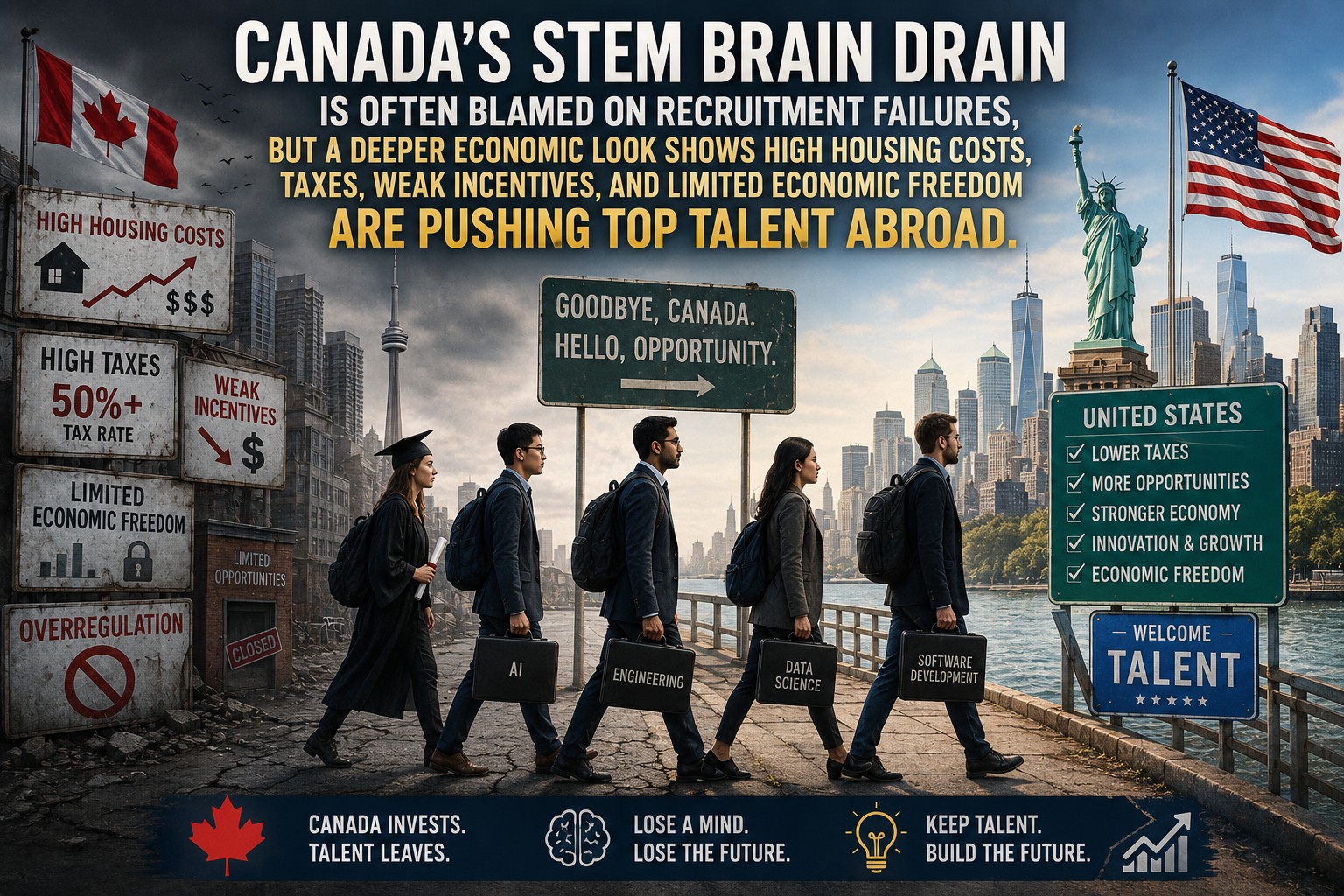
Canada has a serious brain drain problem in science, technology, engineering, and mathematics. But the real story is not simply that Canadian graduates are being tempted away by large American technology companies.
The real story is economic incentives.
A study from researchers at Brock University and the University of Toronto examined why many Canadian STEM graduates leave Canada after completing their post-secondary education. The study found high migration rates among graduates in fields such as software engineering, computer engineering, computer science, engineering science, and systems design engineering.
Software engineering stood out sharply, with a reported 66 percent migration rate. Other STEM programs also showed migration levels above what scholarly literature considers harmful to a country’s economic growth.
The study correctly identifies several reasons graduates leave Canada, including higher pay, stronger firm reputations, and broader career opportunities in the United States. But it misses a deeper economic issue.
Canada is not merely losing talent because American companies recruit aggressively. Canada is losing talent because many skilled graduates are making rational decisions based on income, housing costs, taxation, career mobility, and long-term quality of life.
The Brain Drain Is a Market Signal
From an Austrian economics perspective, Canada’s STEM brain drain should not be treated as a mysterious policy failure. It should be viewed as a market signal.
When talented people leave, they are communicating something through their actions. They are revealing that the opportunities available elsewhere are more attractive than the opportunities available at home.
Governments often respond to this problem by talking about more grants, more public-private partnerships, more awareness campaigns, and more efforts to promote the Canadian technology sector.
But no marketing campaign can overpower bad incentives.
If a young software engineer believes he can earn more, keep more, save more, invest more, and buy property sooner in the United States, then Canada’s branding problem is not the main issue.
The main issue is that Canada’s economic environment may not be competitive enough for the very people it claims it wants to retain.
The Original Study Understates Canada’s Cost of Living Problem
The study discusses higher American salaries, but salary alone is not the full equation.
A worker does not live on gross income. A worker lives on what remains after taxes, rent, mortgage payments, transportation, food, debt payments, and other costs.
That is where Canada becomes much less attractive for many high-skilled graduates.
Canada’s largest technology hubs are also among its most expensive housing markets. Toronto and Vancouver may offer opportunity, but they also offer extremely high living costs. For a young engineer trying to build wealth, this matters.
A higher salary in the United States can become even more powerful when combined with lower housing costs in certain states, lower taxes in certain jurisdictions, and stronger access to private investment opportunities.
The question is not simply:
Can Canada offer a good job?
The better question is:
Can Canada offer a better future?
For many STEM graduates, the answer appears to be no.
Universal Healthcare Is Not Enough To Retain Top Earners
Canadian politicians often point to the country’s government-run healthcare system as a major national advantage.
For lower-income workers, that argument may have real appeal. A government-funded healthcare system can provide security for people who may not otherwise afford private coverage.
But for top-tier earners in technology, engineering, artificial intelligence, software development, and advanced research, the appeal is much weaker.
A highly paid software engineer or technology executive may be perfectly willing to purchase private health insurance if the trade-off is higher income, greater wealth accumulation, better housing options, and more career freedom.
This is one of the blind spots in Canadian political thinking.
Benefits designed to appeal to the average worker may not be enough to retain exceptional workers. High earners often evaluate life differently. They care about upside, mobility, ownership, tax treatment, and freedom of action.
If Canada offers public benefits but reduces private upside, many elite workers will leave for places that reward their productivity more aggressively.
“They Might Come Back” Is Not a Strategy
One optimistic finding from the study is that many graduates say they may return to Canada later in their careers.
That sounds comforting, but it should not be treated as a serious retention strategy.
People often say they might come back when they leave somewhere. It softens the departure. It keeps the emotional door open. But once they build a better life somewhere else, the odds of returning often shrink.
It is like telling an ex you may come back someday after leaving for better prospects. Maybe you mean it in the moment. But once you are courted by better opportunities, higher income, stronger networks, and more freedom, the old relationship becomes less attractive.
Career capital compounds just like financial capital.
A 23-year-old graduate who leaves Canada for the United States may eventually become a 35-year-old senior engineer, founder, executive, investor, or specialist. By then, that person may have deeper professional networks, higher income, a family, property, and a clearer understanding of where their skills are most valued.
As skilled workers age, their value often rises. They become more experienced, more productive, and more selective.
That means Canada may not get a second chance.
High Earners Want More Than Money
Money matters, but it is not the only factor.
High-skilled workers often want liberty, predictability, and control over their future. They want to know that if they work harder, build something valuable, and increase their income, they will not become a political target.
This is where Canada faces a deeper cultural and political problem.

When high earners succeed, they are often treated as convenient sources of government revenue. Politicians promise benefits, subsidies, and programs, but the bill usually lands on the people who are productive enough to pay it.
The politician often escapes blame. The productive worker becomes the target.
This creates resentment and uncertainty. It tells ambitious people that their success may be punished rather than celebrated.
An Austrian economic view would argue that this damages incentives. When a society penalizes production, investment, saving, and entrepreneurship, it should not be shocked when productive people leave.
America Offers Something Canada Struggles To Match: Jurisdictional Competition
The United States has its own political problems. It has left-wing states, right-wing states, high-tax states, low-tax states, heavily regulated states, and more business-friendly states.
But that is precisely the point.
The United States gives skilled workers options.
A talented Canadian graduate can choose California for Silicon Valley, Washington for major technology firms, Texas for business growth, Florida for lower taxes, Tennessee for affordability, or another state that better fits their lifestyle and values.
Each state functions somewhat like its own economic experiment.
Canada is different. Although provinces have differences, the country is more uniform. Federal taxation, national policy, transfer payments, and centralized political culture reduce the degree of real competition between jurisdictions.
For highly mobile talent, this matters.
Skilled workers do not merely choose employers. They choose systems.
Canada Cannot Subsidize Its Way Out of Bad Incentives
Many policy recommendations focus on improving compensation, raising awareness of Canadian tech companies, rethinking co-op placements, and continuing investment in innovation.
Some of those ideas may help at the margins.
But they do not solve the root problem.
If Canada remains expensive, heavily taxed, politically centralized, and hostile to wealth accumulation, then more public spending will not fix the brain drain.
Government cannot sustainably subsidize away the consequences of weak incentives.
If Canadian companies must compete with American salaries while Canadian workers face high housing costs and heavy taxation, the talent problem will continue.
If students graduate with debt and then realize they can build wealth faster elsewhere, they will leave.
If top earners believe success makes them a political target, they will seek jurisdictions where they feel less exposed.
This is not disloyalty. It is rational behavior.
The Real Question Is Not Why Canadians Leave
The study asks how Canada can retain STEM talent.
That is a reasonable question, but it may be the wrong starting point.
The better question is:
Why would top STEM graduates stay?
Would they stay for lower pay?
Would they stay for unaffordable housing?
Would they stay for higher taxes?
Would they stay for slower career growth?
Would they stay because politicians tell them Canada needs them?
Talented people are not national property. They are individuals responding to incentives.
Canada invested in educating many of these graduates, but education alone does not create loyalty. Opportunity creates loyalty. Ownership creates loyalty. Freedom creates loyalty.
Conclusion: Canada’s Brain Drain Is a Warning
Canada’s STEM brain drain should not be dismissed as a temporary recruitment problem. It is a warning about the country’s economic direction.
Canada produces world-class talent, but producing talent is not enough. A country must also create conditions that make talented people want to stay, build, invest, and raise their families there.
If the best graduates believe the United States offers better pay, better housing prospects, better career opportunities, lower taxes in certain states, and greater economic freedom, then Canada’s problem is not messaging.
Canada’s problem is incentives.
Until policymakers admit that cost of living, taxation, housing, regulation, and political hostility toward high earners are part of the equation, the brain drain will continue.
The graduates leaving Canada are not confused.
They are reading the market clearly.
And right now, the market is telling many of them that their future is somewhere else.