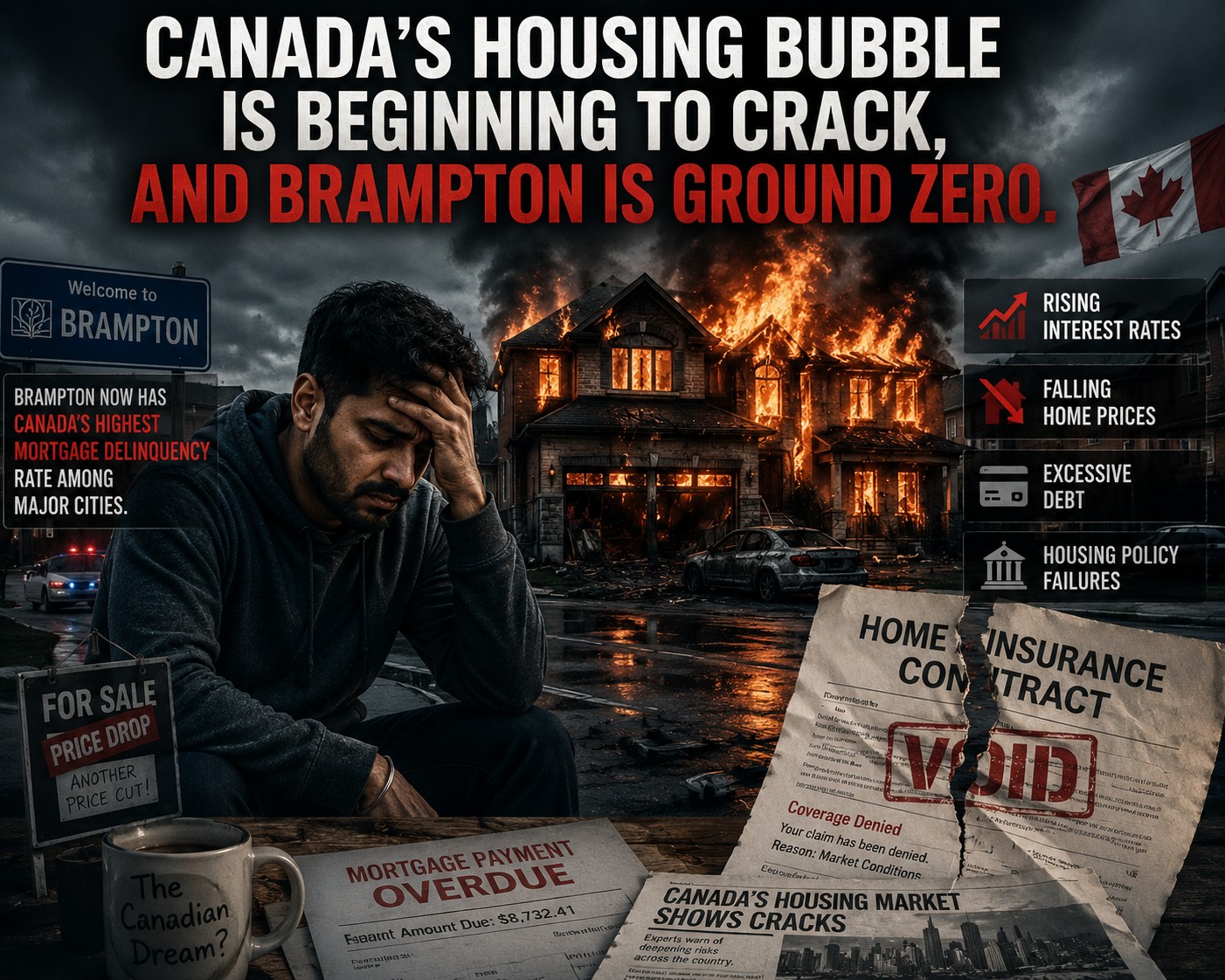

Canada's Housing Bubble Is Beginning To Crack, And Brampton Is Ground Zero
For years Canadians were told that housing prices only move in one direction.
Buy now or be priced out forever.
Stretch a little further.
Take on more debt.
Lock in before prices climb again.
For a generation of Canadians, homeownership became less about shelter and more about survival. The fear of missing out became one of the most powerful economic forces in the country.
Now, some of the first cracks are beginning to appear.
Brampton currently has the highest mortgage delinquency rate among Canada's major cities, with approximately 0.64% of mortgages at least 90 days overdue. While that number may appear small at first glance, it is more than double the national average and has become a warning sign for the broader Canadian housing market.
The story unfolding in Brampton is not about race. It is not about culture. It is not about any particular community.
It is about incentives.
The Problem Isn't Demographics. It's Mathematics.
Brampton is one of Canada's most diverse cities and is home to one of the country's largest South Asian populations. South Asians have historically ranked among the strongest homeownership demographics in Canada and often place a significant cultural emphasis on property ownership, entrepreneurship, family wealth building, and long-term investment.
If anything, these characteristics should strengthen housing stability rather than weaken it.
Focusing on demographics misses the larger issue entirely.
The real problem is that the same economic pressures affecting Brampton would affect any city facing similar conditions.
When housing prices rise beyond local income growth, when debt levels expand rapidly, when interest rates increase, and when housing affordability deteriorates, financial stress eventually appears.
The mathematics do not care about race.
The mathematics eventually catches everyone.
Years Of Easy Money Created Artificial Demand
One of the biggest drivers behind Canada's housing boom was the era of historically low interest rates.
For years, cheap borrowing encouraged households to take on larger mortgages than previous generations would have considered reasonable.
Low rates changed behaviour.
- Families borrowed more.
- Investors purchased additional properties.
- Speculators entered the market.
- Developers expanded construction plans.
- Governments benefited from rising property values.
Housing prices accelerated because demand was being amplified by easy access to debt.
What appeared to be prosperity was often leverage.
As long as rates remained low, the system appeared stable.
Once rates began rising, the weaknesses became visible.
The Mortgage Renewal Shock Has Arrived
The housing market was built around one critical assumption: low interest rates would continue indefinitely.
That assumption proved false.
Today, many homeowners are being forced to renew mortgages at significantly higher rates than they originally qualified for.
For some households, monthly mortgage costs have increased by hundreds or even thousands of dollars.
Many families who comfortably managed their finances during the low-rate era are discovering that the numbers no longer work.
This renewal shock is one of the primary reasons mortgage delinquency rates are climbing across Canada.
Brampton simply happens to be among the first major cities where the effects are becoming visible.
The Pandemic Housing Boom Left Many Buyers Vulnerable
During the pandemic-era housing frenzy, home prices surged to levels few thought possible.
In Brampton, average home values climbed dramatically before retreating as borrowing costs increased.
Many homeowners who purchased near the peak now find themselves holding large mortgages against properties worth significantly less than they were only a few years ago.
For households with limited equity, refinancing options become more difficult and financial flexibility disappears.
What looked like wealth creation during the boom can quickly become financial strain during a downturn.
Immigration Isn't The Problem. Housing Supply Is.
Canada's immigration debate often becomes emotionally charged, but the underlying economics are straightforward.
Population growth increases demand for housing.
The issue is not where people come from.
The issue is whether enough housing is being built to accommodate population growth.
For decades, Canada operated an immigration system that emphasized skills, labour-market needs, and long-term integration.
In recent years, population growth accelerated dramatically while housing construction struggled to keep pace.
The result was predictable.
More people competed for the same housing inventory.
Prices rose.
Rents increased.
Households took on larger debts.
Housing affordability deteriorated.
This is not a racial issue.
It is basic supply-and-demand economics.
Government Spending Cannot Override Economic Reality
Canada's housing market was also supported by years of government stimulus, deficit spending, and policies designed to maintain economic growth.
While these measures may have softened short-term economic pain, they also contributed to an environment where asset prices became increasingly disconnected from underlying fundamentals.
Governments often celebrated rising home values as evidence of economic strength.
But rising asset prices are not always signs of prosperity.
Sometimes they are signs of distortion.
When housing becomes unaffordable for young families, first-time buyers, and skilled workers, rising prices become a warning sign rather than a success story.
Why Brampton Matters
Brampton is important because it may provide an early glimpse into challenges facing other Canadian cities.
The city experienced many of the same forces that shaped the national housing market:
- Rapid population growth
- Strong housing demand
- Rising home prices
- High household debt
- Investor activity
- Interest-rate sensitivity
As those forces reverse, Brampton has become one of the first places where the consequences are becoming measurable.
The city is not necessarily unique.
It may simply be first.
The Austrian Economics View
From an Austrian economics perspective, Brampton's delinquency problem is not the disease.
It is the symptom.
The disease was years of distorted incentives.
Cheap credit encouraged borrowing.
Rising prices encouraged speculation.
Population growth increased demand.
Government policies rewarded asset inflation.
Homebuyers feared being left behind.
Everyone responded rationally to the incentives in front of them.
Now the market is correcting.
Unfortunately, corrections are rarely painless.
Conclusion
Canada's rising mortgage delinquency rates should not be viewed as a Brampton problem.
They should be viewed as a Canadian problem.
The city's growing financial stress reflects broader issues that have been building for years: excessive debt, unaffordable housing, rapid population growth, distorted market incentives, and the lingering consequences of an era of cheap money.
Brampton is not ground zero because of who lives there.
Brampton is ground zero because it represents what happens when housing prices become disconnected from economic fundamentals.
The warning signs are now visible.
The question for policymakers is whether they will address the underlying incentives that created the problem—or continue treating the symptoms while ignoring the cause.